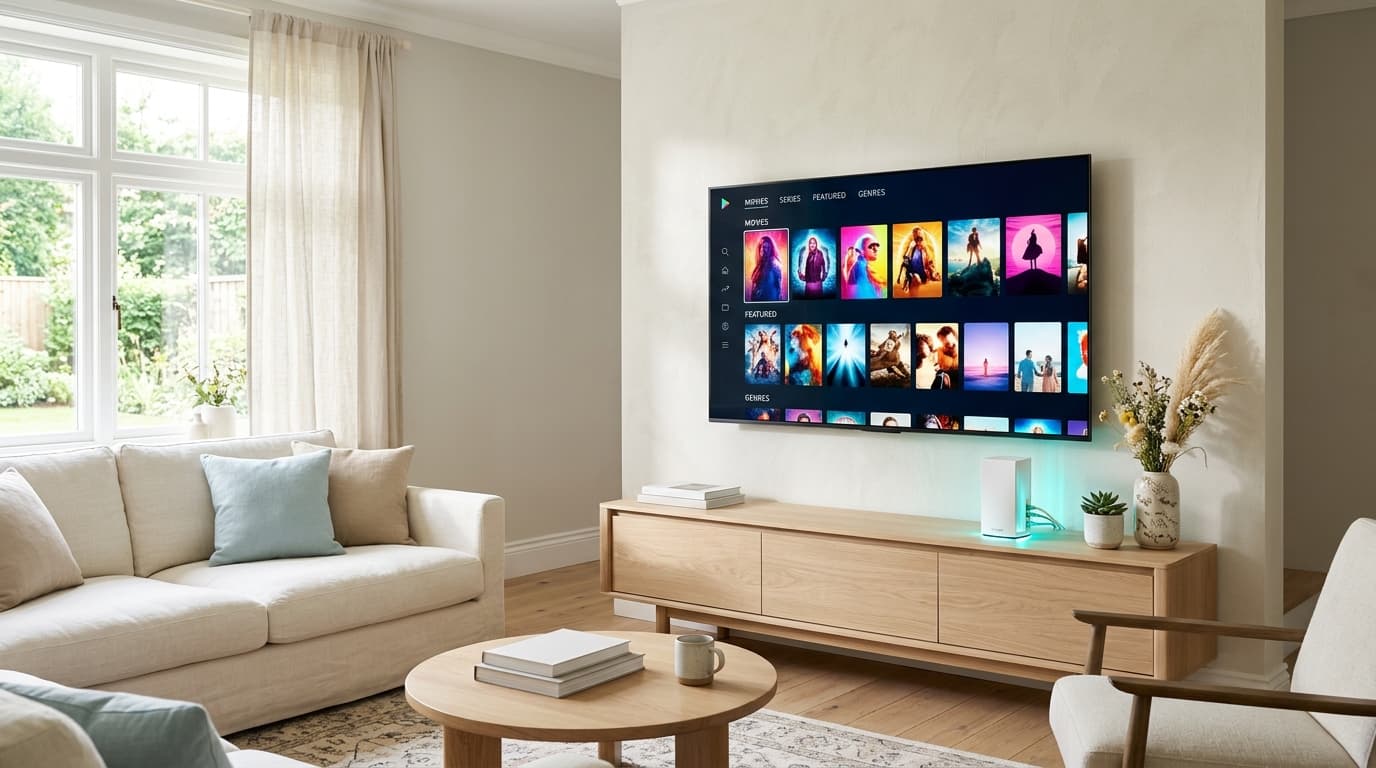
Five megabits per second for a Full HD screen, fifteen to twenty-five for a 4K screen: that is the minimum speed TV over the internet needs, according to the figures the platforms publish themselves. In Belgium, the real question lies elsewhere. Depending on your provider, live TV does or does not borrow your internet speed, and nobody tells you when you pick a tier.
I wanted to know how much a Belgian household really has to set aside for TV. I gathered the official recommendations, went through the providers' documentation and forums, then redid the maths for the tiers sold here.
How many Mbps do you need for IPTV?
IPTV, or Internet Protocol television, covers any television delivered over the internet protocol rather than by aerial, satellite or the classic cable signal. The Proximus Pickx set-top box is one example. So is Netflix, broadly speaking, and so are Auvio or VRT MAX when you open them on a smart TV.
For all these sources, the speed used depends first on resolution. Netflix officially recommends 3 Mbps for 720p HD, 5 Mbps for Full HD and 15 Mbps for 4K. Disney+ sets the bar higher for 4K, with 25 Mbps recommended.
These figures are per screen. Two 4K TVs double the stake.
Speed per screen, checked at the source
Pages answering this question often copy wide, unverifiable ranges. I stuck to the figures published by the platforms and to explanations given by Belgian providers or on their official forums, flagging every estimate.
| Source | Quality | Speed per screen | Uses your internet speed? |
|---|---|---|---|
| Netflix | HD 720p | 3 Mbps (official) | Yes |
| Netflix | Full HD 1080p | 5 Mbps (official) | Yes |
| Netflix | 4K | 15 Mbps (official) | Yes |
| Disney+ | 4K | 25 Mbps (official) | Yes |
| Live Pickx on a Proximus set-top box | HD | about 7 Mbps (subscriber estimate, not published by Proximus) | Yes, with reserved bandwidth |
| Pickx replay and recordings on the V7 box | HD | variable | Yes, like an app |
| Live channels on the Telenet TV-box | HD and 4K | not applicable | No, DVB-C cable signal |
| Telenet recordings and video on demand | HD and 4K | variable | Yes, streamed |
Two remarks. First, Pickx channels are broadcast in HD: specialists on the Proximus forum point out that ultra high definition only concerns apps such as Netflix, not linear channels. Second, Proximus publishes no per-channel speed, and the 7 Mbps order of magnitude comes from subscribers familiar with the older codec, not from an official sheet.
Proximus, Telenet, Orange: TV does not use the same pipe
This is where the investigation becomes Belgian. At Proximus, television has always travelled over the internet line. The provider's spokesperson explained it in February 2026 to VRT, the Flemish public broadcaster: since digital TV launched in 2004, the signal has run over an internet line, and Proximus has not sold TV without internet since 2015. Proximus TV also works at Scarlet and Mobile Vikings, which use the same network.
At Telenet, the picture is different. The TV-box launched in 2019 receives live channels through the DVB-C cable signal, which takes nothing from your internet speed, but it requires a Telenet internet subscription because recordings and video on demand are streamed. Telenet rents it for €11.26 a month, according to the figure reported by VRT in February 2026, and keeps serving the older Digicorder without internet until at least the end of 2026.
Orange, finally, launched a new TV Box on Android TV 14 in early July 2026, free for new customers and sold for €49 to existing ones, with Netflix, Disney+, Auvio, VRT MAX and Streamz preinstalled. Cloud recordings and apps go through the internet connection; Orange does not publicly document how live channels are delivered on each network it uses, so I will not guess on its behalf.
One detail links all three: none lets you watch its TV over a competitor's internet. Telenet cites a "non-public" network to guarantee quality, and the rule is the same at Proximus.

Why does replay stutter when live TV holds?
The answer lies in reserved bandwidth. On Proximus boxes, live TV gets priority on the line, whereas replay and recordings on the V7 box go through the normal internet connection, exactly like Netflix.
On the official Proximus forum, a subscriber on a 50 Mbps line described in 2020 lag on his console and very slow Wi-Fi while playing recordings, never during live TV. Another, on a 27 Mbps line, noted that a 4K Netflix stream on a second screen did not bother his son gaming online, whereas a Pickx recording clearly degraded response time. Two accounts are not a measurement, but they describe the same mechanism, and it explains most complaints along the lines of "live works, the rest stutters".
Another lesson from the same forum: in 2020, a technician refused to install the Android V7 box on a VDSL line of 25 Mbps down and 7 Mbps up, citing a 30 Mbps threshold Proximus has never confirmed publicly. On small lines, the margin is clearly tight.
Which tier is enough for how many screens?
I took the tiers actually sold in Belgium and counted how many simultaneous screens each can carry. Assumptions: a usable speed of about 85% of the subscribed speed, which matches a healthy line at peak time, 25 Mbps per 4K screen to take the most demanding case, and 5 Mbps per Full HD screen.
| Line or plan (checked) | Subscribed download speed | Estimated usable speed | Simultaneous 4K screens | Simultaneous Full HD screens |
|---|---|---|---|---|
| Typical VDSL line outside fiber areas | 25 Mbps | about 21 Mbps | 0 comfortably | 4 |
| Proximus Internet Light Fiber (20/09/2026) | 100 Mbps | about 85 Mbps | 3 | 17 |
| Proximus Go Fiber (20/09/2026) | 150 Mbps | about 127 Mbps | 5 | 25 |
| Telenet Internet Basic (July 2026) | 200 Mbps | about 170 Mbps | 6 | 34 |
| Proximus Mega Fiber (20/09/2026) | 500 Mbps | about 425 Mbps | 17 | 85 |
The finding is clear.
From 100 Mbps upwards, TV no longer saturates a fiber line, even in a family watching three 4K screens at once while keeping room for a video call and a few phones. The only case where speed becomes the limiting factor is the 25 to 50 Mbps copper line, where a 4K screen, live Pickx with its reserved share and the rest of the household genuinely compete for the same capacity, and where a higher tier sometimes simply does not exist at the address.
Then there is upload, which brochures forget. Watching TV uses almost nothing upstream: a few hundred kilobits for commands, acknowledgements and playback statistics. The upload speed of a plan, often five to ten times lower than download in Belgian catalogues, therefore has no effect on picture quality. It matters for video calls and backups, not for the living room.
For the needs of a whole home, our guide to fiber for a family streaming in 4K redoes the maths for a busy evening.
Wallonia, Brussels, Flanders: the bottleneck is not in the same place
FTTH (fiber to the home) coverage stood in mid-2026 at around 78% of homes in Brussels, 71% in Flanders and 44% in Wallonia. These figures move fast, and the coverage atlas of BIPT, the Belgian telecom regulator (IBPT in French), remains the reference for a specific address.
In Flanders, many households watch TV over Telenet's cable: live TV arrives as DVB-C and does not weigh on internet speed, so the tier question mainly concerns apps and video on demand. In Brussels, fiber density makes the question almost theoretical for connected homes. In Wallonia, a large share of households remains on Proximus copper in VDSL or on the former VOO cable, and that is where the table above has concrete meaning: a 25 Mbps line carries HD TV, not an evening of several 4K screens.
Five checks before blaming the subscription
When the picture freezes, the reflex is to call the provider and move up a tier. On fiber, that is rarely the right lead.
- Connect the set-top box or TV over Ethernet. A cable removes the most frequent cause, the Wi-Fi between the router and the screen.
- Test the speed at the exact spot of the screen, not next to the router, and at the time the problem appears.
- Separate live TV from replay. If only replay stutters, the cause is the load on the home network, not the line.
- Check the resolution set in the app. Forced 4K on a small line stutters where Full HD would pass effortlessly.
- Count simultaneous uses: a 100 GB game downloading on the console grabs more speed than three 4K screens combined.
Our method for testing your speed properly details the second step.

Cut-price IPTV subscriptions are a legal problem, not a speed problem
Many pages about IPTV speed actually sell subscriptions to thousands of channels for a few dozen euros a year. In Belgium, these offers are illegal, and the net is tightening. Brought in by RTBF and RTL Belgium, the Brussels Enterprise Court issued an order on 30 January 2026, and the anti-piracy service of the FPS Economy then adopted on 12 February 2026 a blocking decision targeting five services, applied by internet providers, Google and Cloudflare.
For the customer, the risk goes beyond losing the service overnight. Speed changes nothing there.
To choose the line itself, start with our ranking of the best fiber internet offers in Belgium, then check availability at your exact address: that, far more than TV, will decide the tier.
Provider sources consulted: the official Proximus forum thread on V7 box requirements and the Orange Belgium TV set-top box page.
Comparatifs comparator
Compare all comparatifs side by side.
Compare now →
Frequently asked questions
Nicolas suit le marché belge des télécoms et le déploiement de la fibre depuis plus de huit ans. Ancien technicien réseau devenu analyste indépendant, il teste lui-même les connexions qu'il compare : il mesure les débits réels à différentes heures de la journée, lit les conditions ligne par ligne et traque les hausses de prix qui tombent après douze mois. Son objectif : aider les ménages belges à choisir une offre fibre qui tient ses promesses, au bon débit et au juste prix, sans jargon ni argument commercial.