Telenet is the big cable operator in Flanders, and its move to fibre is subtler than it looks. Where Proximus rolls out true fibre to the home across much of the country, Telenet bets first on its heavily modernised cable network — already 95% fibre — while building FTTH fibre through its Wyre joint venture. The result: depending on your address, "Telenet fibre" doesn't always mean the same technology. Speeds up to 2.5 Gbps, a range reorganised in 2026, coverage limited to Flanders: here is our review to know whether a Telenet fibre deal is right for you.
Does Telenet really offer fibre, or cable?
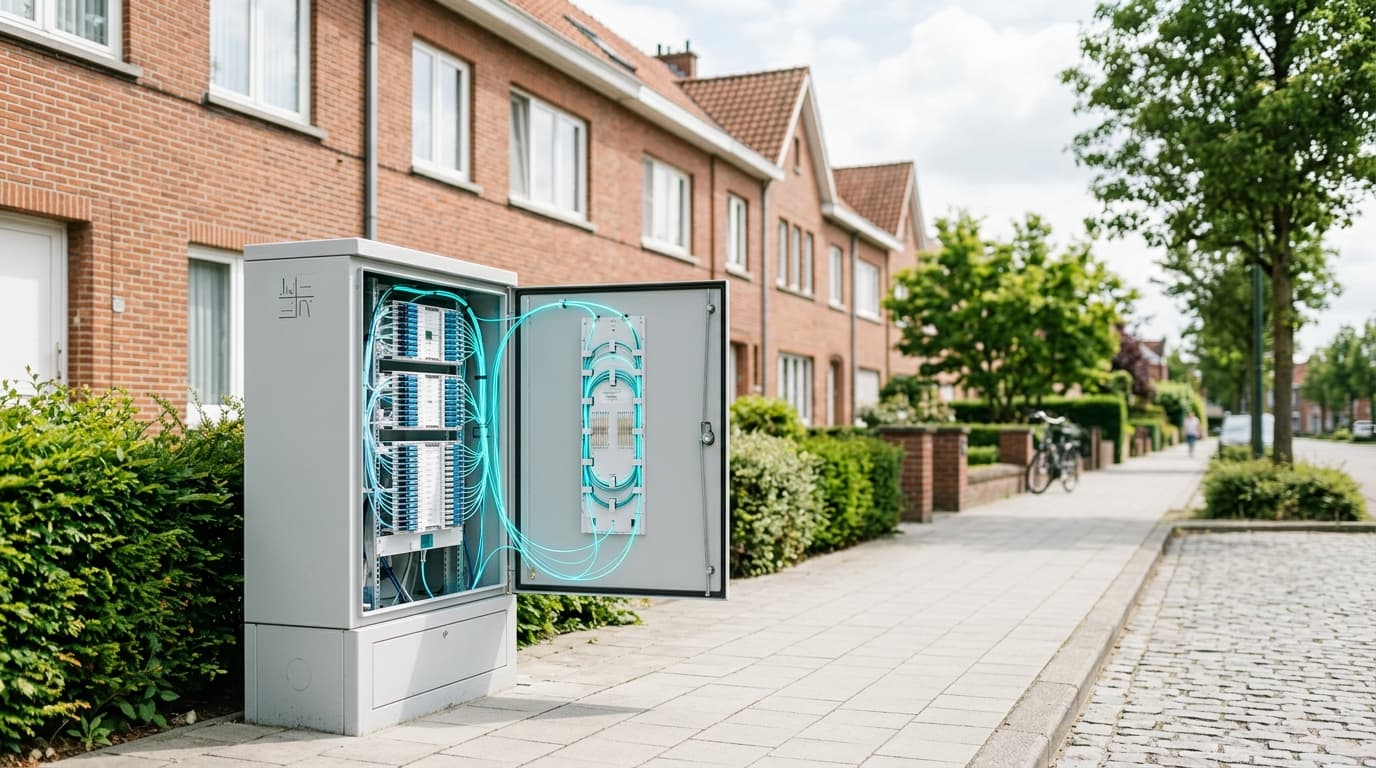
Both — and this is the most important thing to understand. Telenet's network is now around 95% fibre: the optical fibre runs to a point close to your home, and only the last few metres remain coaxial cable. This architecture, called HFC (hybrid fibre-coax), already delivers high speeds, up to 2.5 Gbps download. In parallel, true fibre to the home (FTTH), where the optics physically enter your home, is deployed separately by Wyre, Telenet's joint venture with the Flemish network operator Fluvius. In practice: two neighbouring households both subscribed to "Telenet fibre" may be connected via two different technologies. This isn't a marketing detail — it determines the maximum speed, the stability and the future-proofing of your line.
How much does a Telenet fibre plan really cost in 2026?
Telenet revised its range in 2026 around three internet plans — Basic, Standard and Turbo — rather than its old combined ONE and ONEup bundles. Expect roughly €40 to €85/month depending on speed, with the fastest unlimited internet-only plan (up to 2.5 Gbps) sitting at the top of that range (recorded July 2026). Watch the small print: as with its competitors, these rates are often shown after an introductory promotion. A reduction for the first twelve months is common, which means the bill climbs in the thirteenth month. The real cost, not the entry rate: always work out the spend over two years, promo included, not just the first-year price. That's the only way to compare Telenet honestly against a rival deal.
What speed does Telenet reach, and do you need it?
The Telenet network reaches up to 2.5 Gbps download on its fastest plans. A useful detail: if 2.5 Gbps isn't yet technically available at your address, Telenet says it provides 1 Gbps at the 2.5 Gbps price, with an automatic upgrade once the speed frees up. But let's be clear: almost no household needs such a speed. For 4K streaming on several screens, remote work, video calls and online gaming, a deal around 500 Mbps to 1 Gbps already covers a household's uses very comfortably. The historic weak point of cable isn't the download speed anyway, but the upload, often more limited than on FTTH — a criterion to check if you regularly send large files, back up to the cloud or stream live. Choose a speed suited to your real usage, not the highest figure in the brochure.
Is Telenet fibre available at your address?
This is the first filter to apply, even before price. Telenet mainly covers Flanders and part of Brussels; it is not present in Wallonia, which remains VOO and Orange territory. Depending on your municipality, you'll be connectable either via HFC (the modernised cable, up to 2.5 Gbps) or via true FTTH fibre through Wyre. In April 2026, Telenet, Wyre, Proximus and Fiberklaar signed a deal to accelerate the gigabit rollout in Flanders: in medium- to low-density areas, Wyre and Fiberklaar would build FTTH fibre (about 2 million homes), supplemented by HFC for nearly 700,000 homes in the most rural areas. That deal remains subject to regulatory approval. In Mechelen, for example, the whole city is due to be covered with Wyre fibre by summer 2027. So before comparing prices, test your eligibility at your exact address: it will determine the technology and speed actually within your reach.
How does installation work with Telenet?
Where you're already in a cable area, connection is often the simplest step: Telenet runs an existing network, and activation can happen without major works if a coaxial socket is already present in the home. For a switch to true FTTH fibre through Wyre, however, a technician visit is needed to bring the optics into your home — as with any new FTTH connection. Watch the small print: activation and modem fees vary by plan and by the promotions of the moment. In an apartment or co-ownership, installing fibre on the façade or in shared areas may require the building manager's approval, something to anticipate. Overall, Telenet's historic roots in Flanders make activation a generally well-oiled step on its cable network.
Who is a Telenet fibre deal really for?
Telenet is aimed first at a specific profile: a Flemish household already in an area well covered by its network, that wants a high speed available immediately and, often, a bundle including TV and mobile. If the modernised cable already runs down your street, you get speeds up to 2.5 Gbps without waiting for a new fibre rollout. Who it's for — and who it isn't: if you live in Wallonia, Telenet simply isn't an option. And if you prioritise true FTTH fibre for its symmetric upload and future-proofing, first check whether Wyre or another FTTH provider serves your address. To place Telenet against its competitors and see which deal covers your area at the best price-to-speed ratio, see our ranking of the best fibre internet deals in Belgium.
Telenet versus the competition: what to remember?
Against Proximus, Orange, VOO or Digi, Telenet plays a different tune. Where Proximus rolls out true FTTH fibre very widely and Digi undercuts prices in a few municipalities, Telenet capitalises on an already very capable cable network and on Wyre fibre for the future. Its strength: high speeds available immediately where it's present, and a dominant position in Flanders. Its limit: restricted geographic coverage (no Wallonia), a technology that depends on your address, and an upload historically more modest than pure FTTH. The right approach stays the same as for any provider: check eligibility and the available technology first, then compare the total cost over two years between the deals actually within your reach.
Conclusion
"Telenet fibre" really covers two things: a heavily fibred cable network (HFC) that already delivers up to 2.5 Gbps, and true fibre to the home built by Wyre. Its strength is high speed available immediately in Flanders and a range that's now clearer since the 2026 overhaul. Its limits: coverage restricted to Flanders and Brussels, a technology that varies by address, and introductory promotions that climb after twelve months. Before subscribing, test your eligibility, check whether you're on HFC or FTTH, choose a speed suited to your real usage, and compare the cost over two years against the other deals in your area.
Opérateurs comparator
Compare all opérateurs side by side.
Compare now →
Frequently asked questions
Nicolas suit le marché belge des télécoms et le déploiement de la fibre depuis plus de huit ans. Ancien technicien réseau devenu analyste indépendant, il teste lui-même les connexions qu'il compare : il mesure les débits réels à différentes heures de la journée, lit les conditions ligne par ligne et traque les hausses de prix qui tombent après douze mois. Son objectif : aider les ménages belges à choisir une offre fibre qui tient ses promesses, au bon débit et au juste prix, sans jargon ni argument commercial.