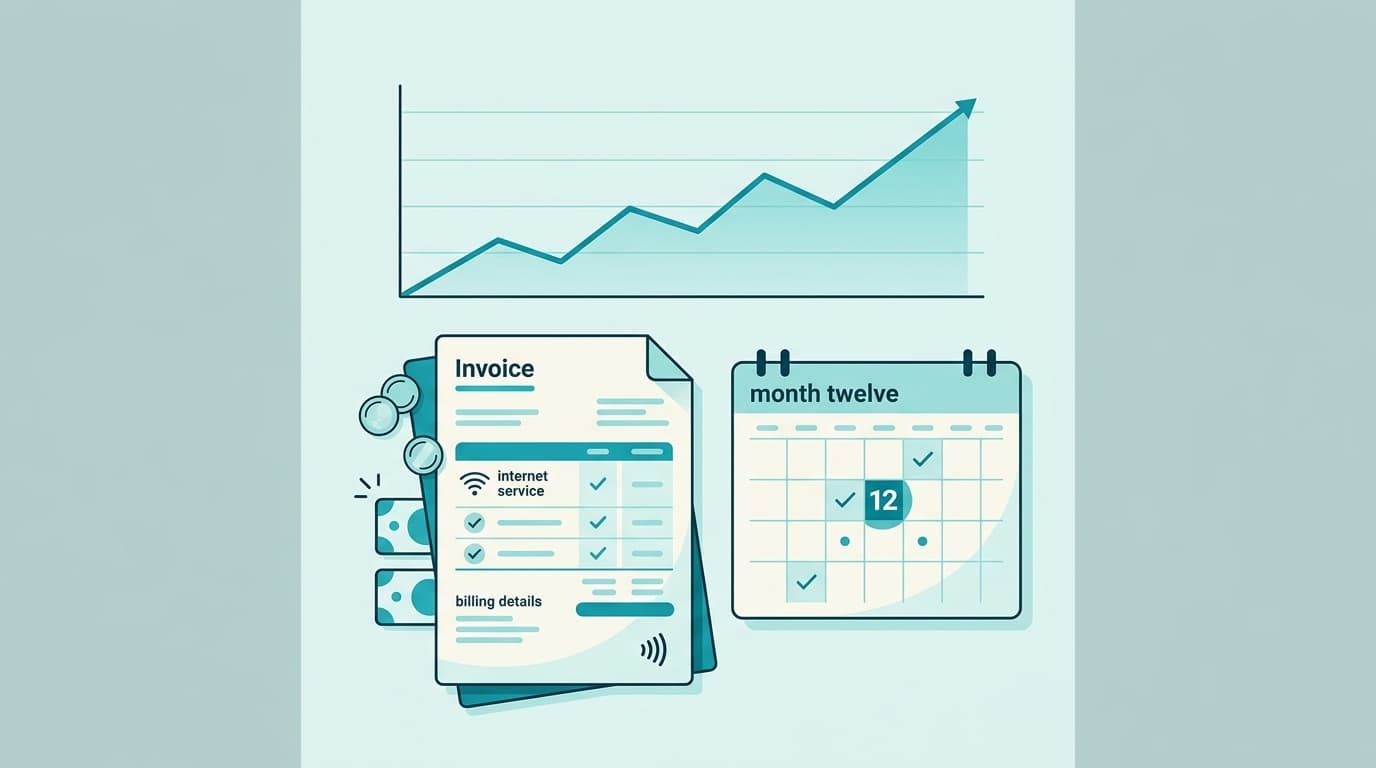
The price on a fibre advert is almost always an intro price: the one for the first few months, not for the year. In Belgium, nearly every mainstream plan cuts the rate for 6 to 12 months, then switches to the "regular price" — and the gap often runs to tens of euros a month. The true cost of a fibre subscription therefore isn't the big promo number, but the small figure that follows "after the promotional period." Here is how to read a promo, work out what you will really pay, and avoid the sharp step after a year. Figures collected in July 2026.
How much does the fibre price rise after the promo in Belgium?
Usually by €10 to €20/month, and sometimes far more on large bundles. That is the order of magnitude seen across most Belgian operators: the first months' promotional rate climbs back to the regular price once the period ends, and the difference is rarely trivial.
The logic is easy to remember: the more spectacular the intro discount, the higher the step at the end. A €15/month reduction on an internet-only plan raises the bill by €15 when the promo ends. But a bundled Internet + TV + mobile plan showing −€35 or −€45/month for the first six months drops you, overnight, to a markedly higher rate. The figure to hunt down is never the one in large type, but the note "after the promotional period, you pay the regular price" — that price is what you will pay for most of your subscription.
Why do operators slash the price for the first months?
Because the intro promo is an acquisition tool, not generosity. The Belgian fixed-internet market is fiercely competitive and the cost of winning a new customer is high; a temporary discount lowers the barrier to signing up and pushes the offer to the top of comparison tables, where the eye lands first on the lowest rate.
This mechanism has a well-known perverse effect: it rewards frequent switchers and penalises loyal customers, who end up at the regular price while newcomers enjoy the discount. That is exactly the criticism aimed at incumbent operators, who sometimes charge their long-standing subscribers far more than their new customers. Understanding this logic is already a defence: a promo is only worthwhile if the regular price that follows stays reasonable.
How long does the promo last, and what is the real price afterwards?
The standard duration is 6 or 12 months, depending on the operator and the type of plan. Here, as examples collected in July 2026, is how the market's main mechanics look — the exact amounts change often, so check them at your address.
At Proximus, mainstream fibre plans show reductions of around €15 to €20/month for 12 months, and some Internet + TV + mobile bundles drop by €35 to €45/month for 6 months before returning to the regular price; fibre internet alone starts around €55/month without promo. At Orange, you find €15/month discounts over 6 or 12 months depending on the plan, with fibre from about €45/month. Telenet, mostly present in Flanders, leans more on cable than on pure fibre, with plans around €36/month for 500 Mbit/s. VOO, now integrated into Orange, no longer takes new subscribers under its brand. And Digi sits at the other end of the spectrum: no exploding intro promo, a constant rate, FTTH fibre from about €20/month.

Promo ending or annual increase: what's the difference?
They are two distinct increases, and they can stack in the same year. The first, the end of the promo, is purely mechanical: it was written into the contract at signing and falls on a fixed date, with no special notice. You knew, when you signed, that the price would climb back up — you just had to have read it.
The second, annual indexation, is a general revaluation of prices decided by the operator. In early 2026, Proximus, Orange/VOO, Telenet and edpnet raised several of their subscriptions and bundles by roughly €1 to €4/month depending on the product, mostly affecting bundles and older contracts. In practice, a subscriber can therefore see the bill rise once at the end of the promo, then a second time at the next indexation. It is this accumulation, more than any single increase in isolation, that widens the gap with the original intro rate.
How do you calculate the true annual cost of a fibre plan?
By smoothing over twelve months what you will actually pay, promo included. The formula fits on one line: (promo price × number of promo months) + (regular price × number of remaining months), all divided by 12. That smoothed figure is the only one that lets you compare two plans on equal footing.
An example makes it obvious. A plan at €30/month for 6 months then €50/month comes to (30 × 6) + (50 × 6) = €660 over the year, that is €55/month smoothed — not the €30 advertised. Against it, a promo-free plan at a steady €40/month costs €480 over the year. The second, though less flashy, is clearly cheaper. That is exactly the kind of reversal the headline rate hides.
Can you cancel without a fee when the price rises?
Generally yes, but only for certain increases. When an operator changes the contract to your disadvantage — typically a price rise decided mid-subscription — Belgian telecoms rules open a right to cancel without penalty, to be exercised within a window after the change is notified. It is a real protection, designed so you are not trapped by an increase you did not choose.
The key nuance: the end of a promo planned from the outset is not a change to the contract. It was known at signing, so it does not open this exit right. Annual price indexation, on the other hand, may grant it depending on the case. To learn the exact conditions and deadlines that apply to your situation, refer to BIPT, the Belgian regulator for postal services and telecoms, which sets out consumers' cancellation rights.
Which fibre plan avoids the price-after-promo trap?
The ones that show a flat rate, with no intro discount meant to explode afterwards. That is Digi's deliberate bet, having entered the Belgian market by breaking the mould: FTTH fibre from about €20/month, a constant price over the contract term, and a public pledge not to raise its prices in 2026. For anyone who hates bill surprises, this model solves the problem at the root — at the cost, admittedly, of a narrower range of options and services than the incumbents.
Conversely, the large bundles from established operators remain where the promo-to-regular gap is harshest: they are worthwhile if you plan to switch operator when the promo ends, far less so if you are after stability over two or three years. The right call depends on your profile, but it always comes down to the same move: compare the after-promo price, not the headline rate. To choose in practice, lean on the official BIPT comparison tool and on our ranking of the best fibre internet plans in Belgium, built around the real price and real speed. If a flat rate tempts you, our detailed Digi review digs into the trade-offs, and our guide to FTTH fibre versus coaxial cable helps place what you are really paying for by technology.
In short, the price after the promo is the real price of your fibre: the one you will pay ten months out of twelve in the first year, then all year after that. Hunt for it in the small print, smooth it over twelve then twenty-four months, and be wary of the most generous discounts, which often hide the highest steps. Once that habit is in place, comparing becomes simple — and the adverts far less impressive.
Prix & promos comparator
Compare all prix & promos side by side.
Compare now →
Frequently asked questions
Nicolas suit le marché belge des télécoms et le déploiement de la fibre depuis plus de huit ans. Ancien technicien réseau devenu analyste indépendant, il teste lui-même les connexions qu'il compare : il mesure les débits réels à différentes heures de la journée, lit les conditions ligne par ligne et traque les hausses de prix qui tombent après douze mois. Son objectif : aider les ménages belges à choisir une offre fibre qui tient ses promesses, au bon débit et au juste prix, sans jargon ni argument commercial.