
Almost every Belgian internet offer calls itself "commitment-free", and the law lets you leave for free after six months anyway. The label is true, but it protects you from nothing: the lock-in that matters is the price that climbs in month thirteen. Here is how to read that label, what it hides and what to calculate instead. Prices recorded on 6 October 2026.
"No commitment": a label on a right everyone already has
The thesis fits in one sentence: in Belgium, the absence of a commitment is not a competitive advantage, it is the backdrop. For a long time, consumers have been able to leave their provider without fees and without a reason once six months have passed, whether the contract is fixed-term or open-ended. A provider that advertises "no commitment" is selling you what the law already gives you.
This is not a quibble over vocabulary. When a label reassures without costing anything, it distracts from what does cost. And what costs is not the length of the contract: it is the rate you will pay for longer and longer.
What does the law say about contract length and cancellation?
Three rules, published by the FPS Economy (the federal ministry for the economy), are enough to understand the ground.
- After six months, you cancel without reason and for free, fixed-term contract or not.
- Before the end of the sixth month, you owe the whole subscription up to that date.
- The notice period written into the contract cannot exceed two months.
A twelve or twenty-four month contract therefore does not lock anyone in for twelve or twenty-four months. It locks you in for six at most. One exception to know: if the provider handed you a free or discounted device, it can claim its residual value, following the amortisation table annexed to the contract. The way out, in practice, is described in our guide to cancelling and switching provider with Easy Switch.
Proximus and Scarlet: two commitment-free offers, two pricing logics
Take two offers that both claim no commitment. On its subscriptions page, recorded on 6 October 2026, Proximus states that all its internet offers are commitment-free. Yet three of its four fibre plans show a starting price valid for twelve months, then a higher one.
At Scarlet, the low-cost brand of the same group, the page mentions no scheduled increase: Loco at €34, Loco Fiber Boost at €44, with free activation until 1 November 2026. According to an indirect reading from callmepower.be, Scarlet imposes no fixed term. Same group, same network, same label, and yet two opposite ways of billing you.
| Offer (recorded 6 October 2026) | Price months 1 to 12 | Price from month 13 | Cost over 24 months | Average price per month |
|---|---|---|---|---|
| Proximus Internet Light Fiber (100 Mb/s) | €39.99 | €39.99 | €959.76 | €39.99 |
| Proximus Internet Go Fiber (150 Mb/s) | €44.99 | €59.99 | €1,259.76 | €52.49 |
| Proximus Internet Mega Fiber (500 Mb/s) | €44.99 | €64.99 | €1,319.76 | €54.99 |
| Proximus Internet Giga Fiber (2 Gb/s) | €57.99 | €77.99 | €1,631.76 | €67.99 |
| Scarlet Loco (150 Mb/s) | €34.00 | €34.00 (no increase announced) | €816.00 | €34.00 |
Author's calculation on advertised prices, excluding one-off web discounts (Proximus announces €180 on Go Fiber and €240 on Mega and Giga Fiber for new customers, valid until 31 December 2026) and installation fees. For Scarlet, the 150 Mb/s speed comes from the provider's page; the price may change, notably with the annual indexation.
Two readings stand out. First, the "no commitment" label is identical for an offer that costs €40 a month all year and for one that goes from €57.99 to €77.99. Second, the web discount does not change the order of magnitude: on Go Fiber it brings the total to €1,079.76 over two years, about €45 a month, which is still above Scarlet's €34 offer.
Does a no-commitment offer cost more?
That is the serious objection, and it deserves to be taken seriously. Selectra notes, in a summary updated in July 2026, that no-commitment offers often cost €5 to €15 more per month than their commitment equivalents. In a market where a longer term buys a discount, the intuition is sound: you pay for your freedom.
Except that Belgian figures partly contradict it. If almost everyone is commitment-free, the freedom premium has vanished: it is absorbed into the base price. Above all, the freedom to leave after six months exists in the most binding contract as in the most flexible one. The surcharge, when there is one, therefore only buys back a five-month window. No more. The useful question is not "with or without commitment?", it is "how much does that freedom cost me over two years?". For a figure by profile, see our comparison of internet only or bundle.
The real lock-in: the month-thirteen price
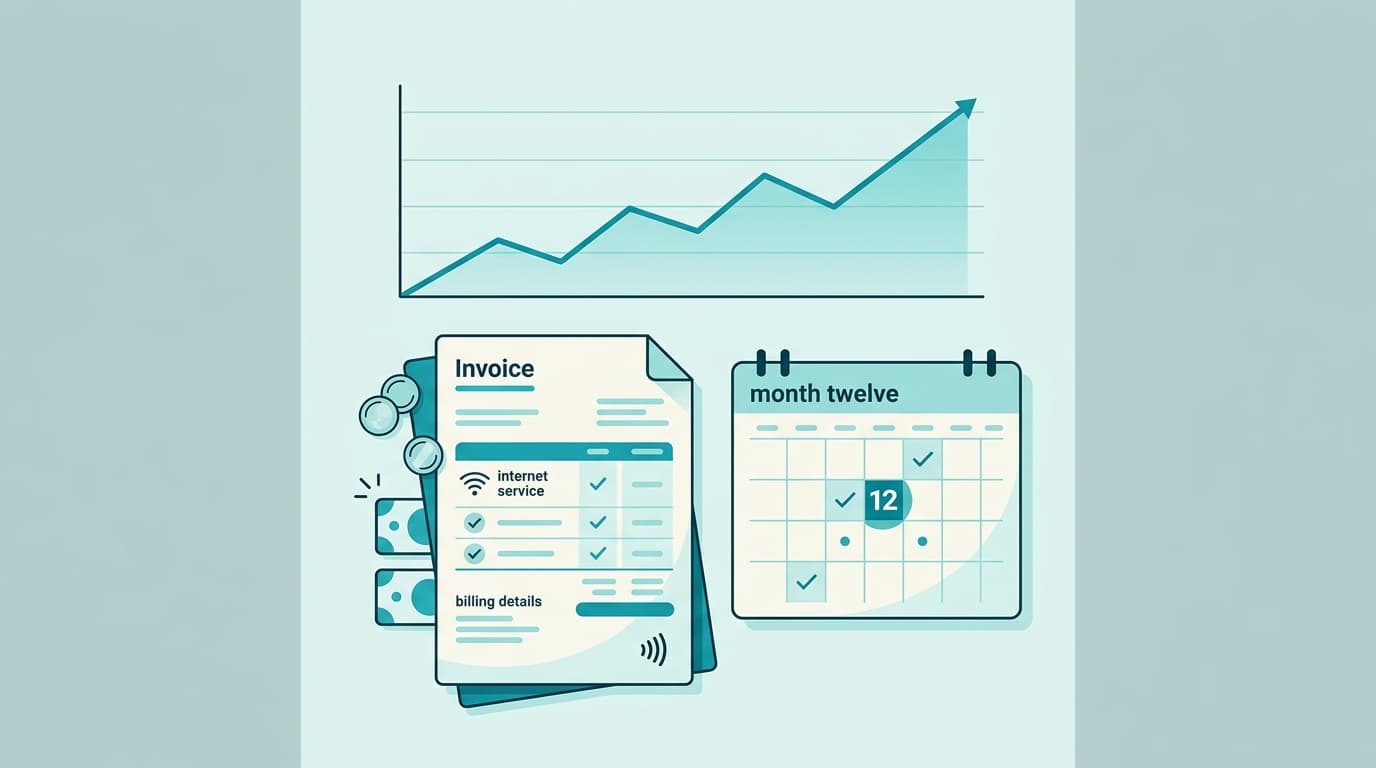
A price that jumps by €15 to €20 in a month does not show on the contract. It shows on the bill. When the promotional rate ends, the choice of staying or leaving arises, and that is where the real commitment appears: it is no longer a clause, it is inertia. Switching provider takes effort, sometimes an appointment, equipment to return. Many households do not do it, and the provider knows it: a bill that goes from €44.99 to €59.99 overnight gets noticed for form's sake, but it is usually paid for months, while the irritation turns into an appointment, the appointment into a comparison and the comparison, at last, into a signature elsewhere. Nine times out of ten, the promise of freedom changes nothing.
The average price gap between the advertised rate and the one actually paid gives the measure: from €7.50 a month on Go Fiber (52.49 against 44.99) to €10 a month on Giga Fiber (67.99 against 57.99). It is the same mechanism as in our analysis of the fibre price after the promotion.
What happens if you leave before six months?
The FPS Economy's general rule is clear: the subscription remains owed until the end of the sixth month. Providers, for their part, advertise "no fees". The two messages do not match, and this is the exact point where you should read the general terms, not the sales page. Here is what the general rule would give on a €44.99 monthly offer, an indicative calculation to confirm with the provider.
| Leaving in month | Instalments still owed up to month 6 | Indicative amount |
|---|---|---|
| 2 | 4 | €179.96 |
| 4 | 2 | €89.98 |
| 6 | 0 | €0 |
| After month 6 | none | €0 |
In practice, the amount also depends on the equipment supplied and activation fees already paid. And if a provider claims a sum that is neither a subscription balance nor the residual value of a device, ask for the details in writing. In a dispute, the Ombudsman Service for Telecommunications steps in free of charge.
How do you check the real commitment before signing?
Five checks, in order, take less than ten minutes.
- Find the line "price after the promotional period" and note it: it is your real rate.
- Calculate the total over twenty-four months, discounts included, then divide by twenty-four.
- Spot the equipment supplied: TV box, mobile device, any amortisation table.
- Read the clause on the first six months in the general terms, not in the advert.
- Put the end-of-promo date in your diary, thirty days ahead: that is the moment to compare.
I could not verify the commitment terms of Orange, Telenet, VOO or Digi at the time of this survey: their pages were either unreachable or silent on the subject. That silence is information in itself, because it forces you to do the reading yourself.
Three regions, three catalogues
Fibre rollout is very uneven: around 78 % of homes in Brussels, 71 % in Flanders and 44 % in Wallonia in mid-2026, figures that keep moving. That changes what you can compare. Depending on the address, the catalogue relies on the Proximus, Fiberklaar or Wyre networks, and two neighbours down the same street do not always have access to the same providers. Telenet is strongest in Flanders and Brussels, VOO in Wallonia and Brussels, Proximus everywhere. A Walloon household in a poorly covered area sometimes has two offers to compare, a Brussels household has more, and it is precisely that imbalance that makes the twenty-four month calculation more useful than any brand ranking.
Prix & promos comparator
Compare all prix & promos side by side.
Compare now →
Frequently asked questions
Nicolas suit le marché belge des télécoms et le déploiement de la fibre depuis plus de huit ans. Ancien technicien réseau devenu analyste indépendant, il teste lui-même les connexions qu'il compare : il mesure les débits réels à différentes heures de la journée, lit les conditions ligne par ligne et traque les hausses de prix qui tombent après douze mois. Son objectif : aider les ménages belges à choisir une offre fibre qui tient ses promesses, au bon débit et au juste prix, sans jargon ni argument commercial.