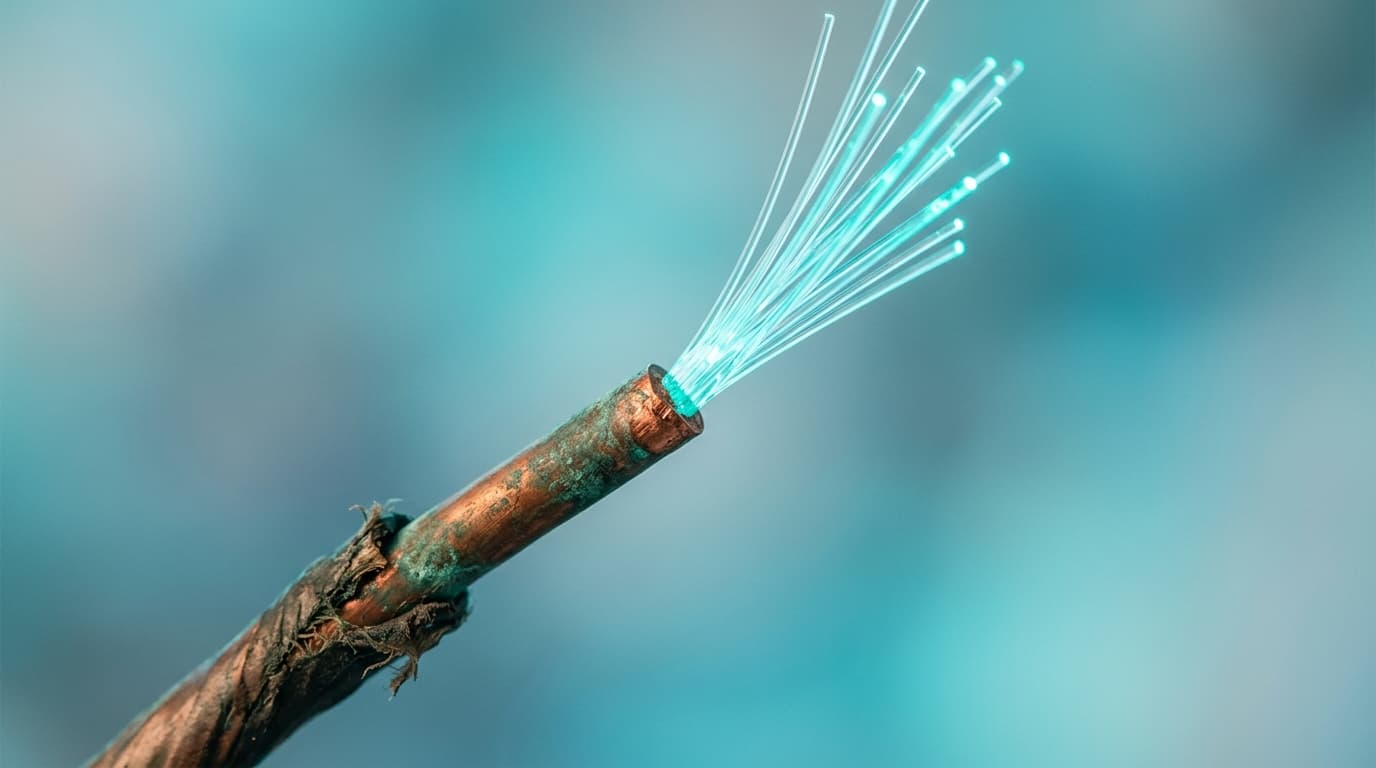
For years, Belgian fixed internet ran on infrastructure designed for the telephone: the copper pair. VDSL squeezed the most out of it, but it is hitting its limits, and fibre is taking over wherever it arrives. The real question is no longer "fibre or VDSL" in the abstract, but "how long will my copper keep going, and what do I gain by switching". Here are the concrete differences in technology and speed, what changes in daily use, and when the move becomes worthwhile — or unavoidable. Figures collected in July 2026.
What is the difference between VDSL and fibre in Belgium?
VDSL carries internet over the old copper telephone line; FTTH fibre brings a glass cable all the way into your home. That is the whole difference, and it explains almost everything else.
With VDSL, fibre already exists, but it stops at the street cabinet, the local sub-repeater. The last stretch — sometimes a few dozen metres, sometimes several hundred — runs on copper, the same twisted pair that once carried your phone. And copper loses signal with distance: the further you are from the cabinet, the more your speed drops. FTTH fibre (for Fiber To The Home) removes this weak link: glass runs end to end, with no copper at all. As a result, distance barely matters, and the advertised speed is the one you actually get.
Is VDSL really slower than fibre?
Yes, and the gap is clear, especially on upload. In Belgium, VDSL in practice tops out around 50 to 100 Mbit/s downstream depending on the length and quality of the line, and above all around 10 to 20 Mbit/s upstream. Fibre, by contrast, is symmetric and ranges from several hundred Mbit/s to several Gbit/s depending on the plan.
Downstream speed (what you download: pages, videos, games) is often enough on VDSL for moderate use. It is upload, the upstream speed, that opens up the difference. VDSL is asymmetric: it gives a lot on the way down, very little on the way up. Fibre treats both directions equally. In daily use, that changes everything the moment you send: stable video calls even with several people, fast cloud backups, sharing large files, remote work without drops when someone else is watching TV in the next room. On top of that, fibre offers lower and steadier latency, valuable for online gaming and calls.

Will the copper network disappear in Belgium?
Yes, gradually, and the timetable is already running. Proximus stopped marketing new copper subscriptions on 31 March 2024, then switches the network off address by address, roughly five years after fibre reaches that spot. Full shutdown is announced on a 2030-2035 horizon.
So this is not a distant, abstract threat. In already-fibred areas, some households are receiving notice right now: their copper line will be cut off on a given date, and they must have switched to fibre by then. If your street is fibred, the countdown has probably already begun, even if you have not yet received the letter. Anticipating the move, rather than being forced into it a few weeks before the cut-off, avoids nasty surprises — especially for equipment plugged into the old phone socket.
Should you move to fibre as soon as it is available at your address?
Not in a rush while your VDSL works and is enough for you — but it is the direction of travel, and the tipping point comes sooner than you think. The right way to decide is to look at your usage, not the brochure.
If your connection struggles on upload, saturates as soon as several devices are running, or drops in the evening at peak times, fibre fixes all three at once. If you mostly check email, watch TV and browse without particular demands, VDSL can still hold for a few years without you feeling the difference day to day. The trigger often comes from a change in life: regular remote work, 4K streaming on several screens, teenagers gaming online, or simply the announcement that copper is being cut off at your address. To gauge more finely what you gain by technology, our guide to FTTH fibre versus coaxial cable usefully completes the comparison with copper.

Is fibre available everywhere in Belgium?
No, not yet, and that is the main brake on switching. In 2026, FTTH fibre covers about half of Belgian households depending on the measure used, with wide regional gaps: Brussels and the large Flemish cities are well advanced, while rural Wallonia lags clearly behind.
The rollout is progressing at a good pace, driven by Proximus and its partners — Fiberklaar in Flanders, Unifiber in Wallonia — aiming for much broader coverage by the end of the decade. But a national average says nothing about your street: two neighbouring houses may be one connectable, the other not, depending on how far the works have got. So the only figure that matters is a test at your exact address. Our guide to checking fibre availability at your address sets out the official tools and the four possible coverage states, from "already connectable" to "no fibre planned".
How much does moving from VDSL to fibre cost?
Often less than feared. Fibre installation is frequently offered free as part of a sign-up promotion, and monthly fibre rates are comparable — sometimes lower — than VDSL, especially at new entrants like Digi, which broke the market's prices.
The real cost to watch is not the connection, but the price after the promotion. Most plans cut the rate for six to twelve months, then switch to the regular price, often €10 to €20/month more. It is that price, not the headline rate of the first months, that you should compare between plans: our analysis of the fibre price after the promo explains how to work out the real annual cost. To choose a plan in practice based on real speed and the smoothed price, lean on our ranking of the best fibre internet plans in Belgium.
In short, fibre and VDSL no longer play in the same league: one is the technology of the future, symmetric and lossless; the other is the last breath of a network built for the telephone. The switch need not be rushed, but it is written: better to make it at the right moment, with eyes open, than in the panic of a copper cut-off. Start by testing your address — the rest is just a matter of real speed and price.
Débit & technologie comparator
Compare all débit & technologie side by side.
Compare now →
Frequently asked questions
Nicolas suit le marché belge des télécoms et le déploiement de la fibre depuis plus de huit ans. Ancien technicien réseau devenu analyste indépendant, il teste lui-même les connexions qu'il compare : il mesure les débits réels à différentes heures de la journée, lit les conditions ligne par ligne et traque les hausses de prix qui tombent après douze mois. Son objectif : aider les ménages belges à choisir une offre fibre qui tient ses promesses, au bon débit et au juste prix, sans jargon ni argument commercial.