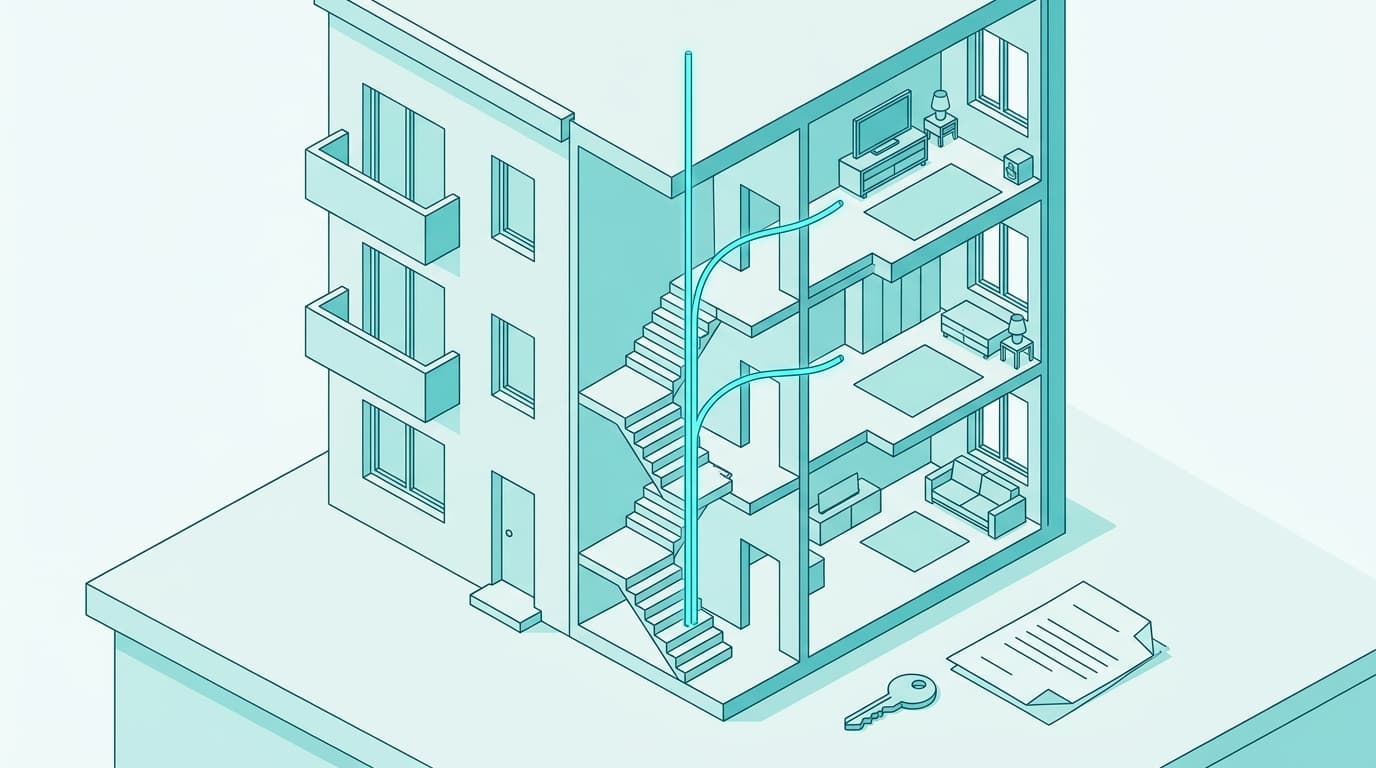
You rent, fibre runs down your street, and you are wondering whether you are allowed to bring it inside. Yes — but you cannot force it. Subscribing to a fibre plan on an existing socket needs nobody's permission. The moment the connection requires drilling, cable-running or work in the shared parts of a building, your landlord's written consent becomes necessary, and Belgium has no "right to fibre" comparable to the French one. Here is the decision table, the text that actually matters, and what to do in each case. Checked in August 2026.
Can I have fibre installed as a tenant, yes or no?
Yes, and tens of thousands of Belgian tenants do it every year. But the useful answer is finer than the yes, because it hangs on one question: is your home already connected?
If an optical socket is already fitted, or if the connection box is already present in the building, you sign a subscription like any other customer. No authorisation, no approach to the landlord: you are buying a service, not building work. That is the most common case in recent buildings and in streets where the crews have already been.
If the property is not connected, installation means physical actions on the building: a duct to use, a façade to cross, a cable to fix, sometimes a conduit to drill between the landing and the flat. Those actions touch someone else's property. A Belgian lease may perfectly well forbid works, improvements and alterations without the landlord's prior written consent, and that clause appears in the vast majority of contracts here.
Which case are you in, exactly?
Four situations cover almost every request. Find yours before reading on — the steps differ completely from one to the next.
| Your situation | Consent needed? | From whom | Legal basis | Who pays |
|---|---|---|---|---|
| Optical socket already fitted in the home | No | Nobody | Subscription contract | You (subscription, possible activation fee) |
| Detached house, not connected, works under way in the street | Yes | The landlord | Works clause in the lease | Connection free during the works |
| Flat, building already cabled to the landings | Yes, if drilling into the flat | The landlord | Works clause in the lease | Connection free, activation depends on plan |
| Flat, building not cabled | Yes, twice over | The landlord and the owners' association | Lease + article 3.82 of the Civil Code | Infrastructure operator, free of charge |
The last row is the one that gets stuck, and the only one where Belgian law says something precise. It deserves to be explained properly, because almost everything circulating in French on this subject is wrong for Belgium.
Does a tenant "right to fibre" exist in Belgium?
No. And this is where a French-language search will reliably mislead you.
In France, a series of texts guarantees tenants a right of access to fibre: the landlord may only object for a serious and legitimate reason, silence for three months counts as tacit agreement, and a refusal can be challenged before a departmental conciliation commission. Those rules are extensively documented, well ranked in search results, and they have no force in Belgium. Neither the conciliation commission, nor the three-month deadline, nor tacit agreement exist in our law.
What does apply here is, first, tenancy law — devolved to the Regions, so different in detail in Wallonia, Brussels and Flanders, but convergent in principle: a tenant may carry out improvement works, the lease may make them subject to the landlord's prior written consent, and the tenant can claim no compensation at the end of the lease for what they improved. And second, in apartment buildings, co-ownership law, which is federal and sits in Book 3 "Property" of the Civil Code.

What does article 3.82 of the Civil Code say about fibre in shared parts?
This is the decisive text, and it is far more favourable than people assume — provided you are the right person.
Article 3.82, § 2 of the Civil Code provides that individual co-owners and licensed utility service operators have a legal and free-of-charge right to install, maintain or repair cables, ducts and associated equipment in or on the shared parts, where the works optimise infrastructure for energy, water or telecommunications, and where the other co-owners bear no financial burden as a result.
The procedure is framed. The co-owner or the operator sends, at least two months before the works begin, a registered letter to the syndic — or to all co-owners if there is none — stating the sender's address, a description of the intended works and evidence of the optimisation achieved. Co-owners then have two months to object, by registered letter and on pain of forfeiting their rights, on the basis of a legitimate interest.
That legitimate interest is not left to general appreciation: the text lists it exhaustively.
| Ground for objection allowed by article 3.82 | What it covers in practice |
|---|---|
| Equivalent infrastructure already exists in the shared parts concerned | The building is already cabled with fibre by another operator |
| Serious harm to appearance, use of shared parts, hygiene or safety | Listed façade, cramped stairwell, obstruction of a fire escape |
| No optimisation, or financial burden shifted onto other co-owners | Redundant works, or works whose upkeep would be billed to the association |
"I would rather nothing were touched", "let's look at it later", or no answer at all do not appear on that list. An objection must be stated, reasoned and served within two months — silence does not block the works.
Then comes the limit that concerns you directly: this right belongs to the co-owner and to the operator. Not to the tenant. As an occupant you cannot trigger the procedure yourself. You can, however, make sure somebody who can does — and that is exactly what the operator does.
How do you get a building connected when nobody has asked?
This is the move that works, and it is surprisingly simple: you do not have to win over the general meeting, you have to put the operator in touch with the syndic. The rest is the statutory procedure above, which the operator knows and funds.
In four steps:
- Identify the network available at your address. In Belgium the operators you can actually subscribe to depend on the wholesale network rolled out in the street — Proximus, Fiberklaar or Wyre. Two neighbouring buildings can fall under different network builders, with different catalogues.
- Send the syndic's contact details to the infrastructure operator. Proximus provides the address
syndic@proximus.com: a registered letter then goes to the syndic, who can put the request to the next general meeting. Fiberklaar, for its part, arranges a technical survey of the shared parts with the syndic or owner, followed by a report submitted for approval. - Tell your landlord in parallel. They are a co-owner, they may vote at the general meeting, and they have every interest in knowing the operation costs them nothing.
- Request your individual connection once the building is equipped. Vertical cabling and connecting your own flat are two distinct stages; the second is quick.
Who pays for the fibre connection, the tenant or the landlord?
Neither, in the normal scenario — and that is the answer that unblocks the most cases.
The connection to the network is funded by the infrastructure operator. With Proximus, it is "completely free during the period when works are taking place in your street", whether or not you are a customer. With Fiberklaar, the works in the street, in the shared parts and into the flat are covered as long as the building can be connected to the network. Article 3.82 imposes the same logic in co-ownership: the right to install is exercised free of charge and without financial burden on the other co-owners.
What does get billed is the subscription and, depending on the plan, an activation fee. Checked in August 2026: Proximus charges €59 in installation fees on an internet-only Fiber plan and on certain combinations, but waives them on Flex Fiber bundles. These amounts move with commercial campaigns, which is one more reason to look at the two-year cost rather than the headline price — we set out the arithmetic in our article on the price of fibre after the promo ends.
Two caveats matter. First, a connection requested long after the works have moved on may indeed be charged: Proximus states that installation remains possible afterwards but that additional fees may apply. Second, any comfort cabling inside the home — a flush-mounted conduit, an extra socket in another room, a tidy run behind skirting — falls outside the free scope and is either negotiated with the landlord or paid for by you.
What if the landlord or the syndic refuses?
Separate the two refusals, because they differ in nature and in remedy.
A landlord's refusal is, under Belgian law, hard for a tenant to challenge. You have no "right to fibre" to invoke. What works is the written argument: the connection is free, it commits you to no purchase, it adds value to the property, and the cabling stays behind when you leave. State that you will bear any comfort work yourself and document the condition report. The great majority of refusals rest on fear of an invoice or of damage, not on opposition in principle.
A refusal by the syndic or the general meeting does follow a rule. If the operator gave proper notice under article 3.82, an objection must be raised within two months, by registered letter, on one of the three exhaustive grounds. An objection out of time or without an admissible ground is forfeited. And a co-owner outvoted by a general meeting decision they consider irregular or abusive has a judicial remedy, within four months of the decision. That remedy belongs to the co-owner, not the tenant — hence the value of having your landlord on side.
If the deadlock persists, the Telecommunications Ombudsman Service handles disputes with an operator, but it has no jurisdiction over a landlord-tenant disagreement or a co-ownership decision: those go before the justice of the peace.
Does your region change the answer?
On co-ownership law, no: article 3.82 is federal and applies identically in Brussels, Flanders and Wallonia. On tenancy law, yes in the detail — residential leases have been a regional competence since 2014, with three distinct regimes — but all three converge on the point at hand: works modifying the rented property require the landlord's consent, and written consent is the only serious protection for tenant and owner alike.
Where the region changes everything is availability. FTTH rollout remains very uneven, and public estimates vary depending on whether you count homes passed or homes actually connectable: as of mid-2026 you will read figures of the order of 75 to 78 % of households eligible in Brussels, between 40 and 70 % in Flanders depending on method, and 18 to 44 % in Wallonia. The spread between sources is itself instructive: no regional average will tell you what is feasible in your street.
The one reference to consult is the FTTH map published by the BIPT, the Belgian telecoms regulator, which publishes rollout status by address. Three practical consequences:
- In Brussels, the obstacle is rarely the network — it is almost always the co-ownership. The housing stock is overwhelmingly collective and old: the syndic is who you need to reach.
- In Flanders, Fiberklaar and Wyre are rolling out heavily and actively approaching syndics; an unequipped building will often be equipped within months, and a well-placed request speeds things up.
- In Wallonia, coverage is still the prior question. A large share of the territory is served by the coaxial cable of the former VOO network, now operated by Orange, where gigabit download exists but upload is capped. Comparing the plans you can actually subscribe to at your address is essential — which is the purpose of our ranking of the best fibre internet plans in Belgium.
What if the building will not be connected any time soon?
Do not stay fixated on fibre. Three options require no works and no permission, because they rely on infrastructure already present or on radio.
VDSL over the existing phone line delivers, depending on distance to the exchange, 30 to 100 Mbps: not enough for a large household, plenty for one person. Coaxial cable, if a TV coaxial socket is already fitted, gives access to high download speeds — up to a gigabit — with far more limited upload than fibre. Finally, fixed 4G or 5G needs only a box near a window: zero drilling, zero consent, but performance tied to mobile coverage. The concrete differences are set out in our comparisons of fibre versus VDSL and FTTH versus coaxial cable.
One last reflex for a tenant: while the situation is unsettled, favour a no-commitment or short-commitment plan. If the building is connected six months later, or if you move, you do not want to pay a penalty to get out — the procedure and the fees are set out in our guide to cancelling your contract and switching provider.
What happens to the installation when you move out?
It stays. The optical box, the socket and the indoor cabling are fixed to the property and benefit the owner: that is precisely the argument to make when asking for consent. A tenant who carries out improvement works can neither claim ownership of them nor demand compensation at the end of the lease, unless agreed otherwise.
What leaves with you is the operator's equipment: modem, set-top box, remote, cables. It belongs to the operator and must be returned on cancellation, failing which a charge applies.
Hence the single real precaution: put the agreement in writing before the intervention, with a description of the works, a statement that the connection is free, and what has been agreed about the exit condition report. An email accepted by the landlord is enough to head off every dispute I see raised on this subject.
In short, the question is not legal but practical: work out whether your home is already connected, and if it is not, escalate to the infrastructure operator rather than exhausting yourself in personal approaches. Belgian law gives you no magic wand, but it gives the operator powers you do not have — and nothing stops you from setting them in motion.
Installation & éligibilité comparator
Compare all installation & éligibilité side by side.
Compare now →
Frequently asked questions
Nicolas suit le marché belge des télécoms et le déploiement de la fibre depuis plus de huit ans. Ancien technicien réseau devenu analyste indépendant, il teste lui-même les connexions qu'il compare : il mesure les débits réels à différentes heures de la journée, lit les conditions ligne par ligne et traque les hausses de prix qui tombent après douze mois. Son objectif : aider les ménages belges à choisir une offre fibre qui tient ses promesses, au bon débit et au juste prix, sans jargon ni argument commercial.