The modem is blinking, the page will not load, and the first question is not "who do I call" but "is this coming from my end?". Five minutes are enough to settle it. The second question is more interesting, and almost nobody knows the answer: since 1 November 2024, a total outage lasting more than eight hours creates a statutory right to compensation in Belgium — modest, automatic in some cases, and refused in six others. Here is the procedure, in order, and the exact scale. Verified in August 2026.
Network outage or a problem at home: how do you tell in five minutes?
One test settles it, and it is not rebooting the box.
Plug a laptop straight into the modem with an Ethernet cable, then switch off the machine's Wi-Fi. Three possible outcomes, three conclusions:
- Nothing over the cable either. The line is dead. The problem lies upstream of your home — the network, the connection, or the provider's own equipment. Skip straight to the next section.
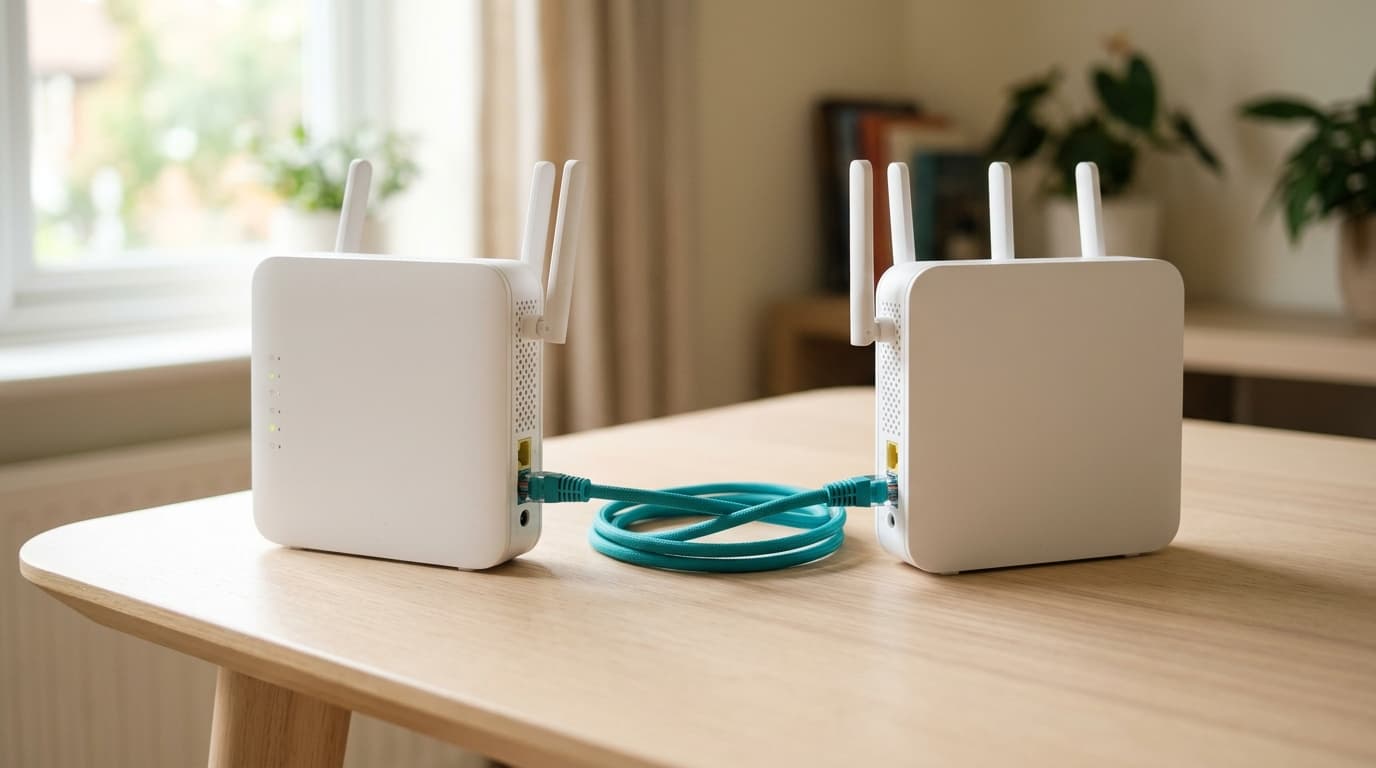
- Everything works over cable but not over Wi-Fi. Your subscription is perfectly healthy. It is your wireless network that is failing, and no compensation will be due: internal wiring and household equipment are explicitly excluded from the statutory scheme. Our comparison of Wi-Fi extenders, powerline adapters and mesh systems covers that case end to end.
- It works intermittently. Neither outage nor normality: the most infuriating case, and also the one that opens no entitlement, since the law requires a total interruption.
Second check, thirty seconds: ask a neighbour on the same provider. If their connection is down too, the outage is widespread — and the least known condition of the scheme is already met, as we will see below.
How do you report an internet outage to your provider?
Report it, even when the outage is obviously widespread and the whole neighbourhood is complaining on Facebook. This is not a matter of courtesy: your report is what timestamps the incident in the provider's system and, for a whole category of outages, what conditions payment of the compensation.
The procedure runs to five steps.
- Check the network status on your provider's official page or in its app, before calling. You will find out whether the incident is already known and whether a restoration time has been announced.
- Open a ticket in your own name, by phone, chat or app. An "already known" incident is not a ticket: without a named file, your address is not on the list of affected customers.
- Note the exact time of your report and the ticket number. Those are the only two pieces of evidence that matter afterwards.
- Stop unplugging things once the ticket is open, and above all do not postpone the engineer appointment you are offered: a postponement requested by the customer suspends the right to compensation for the days concerned.
- Note the restoration time as well. It closes the count and starts the thirty-day window for filing the claim.
| Provider | Where to check network status | How to report | Physical network used |
|---|---|---|---|
| Proximus | MyProximus app, online help page | MyProximus chat, customer service | Proximus network (copper and FTTH) |
| Telenet | My Telenet, "faults" page | My Telenet, customer service | Telenet cable network, Wyre FTTH |
| Orange | My Orange app, support page | My Orange, customer service | Orange network, former VOO cable, third-party FTTH |
| VOO | myVOO, VOO assistance | 078 50 50 50 | Former VOO cable network (Orange group) |
| Scarlet, edpnet, resellers | The brand's customer portal | The brand's customer service | Proximus, Fiberklaar or Unifiber wholesale network |
Channels recorded in August 2026. Customer service numbers change regularly: the one printed on your bill is authoritative. 078 50 50 50 is the number VOO itself publishes for reporting a service interruption.
That last row deserves a pause. If your line runs over a wholesale network — Proximus, Fiberklaar or Wyre — that your provider does not operate itself, the repair depends on a third party you have no way of reaching. Your point of contact, and your debtor, remain your provider.
From what point does an outage create a right to compensation?
From eight consecutive hours of total interruption. That is the threshold set by the Electronic Communications Act of 13 June 2005, in the version applicable since 1 November 2024, and repeated verbatim by BIPT — Belgian Institute for Postal Services and Telecommunications, the national telecom regulator.
Past that threshold, the compensation accumulates in steps.
| Duration of total interruption | What you are owed |
|---|---|
| Under 8 hours | Nothing. No statutory entitlement. |
| The 16 hours following the first 8 | €1.00 |
| From 24 hours | €2.00 |
| Each subsequent 24-hour period | + €0.50 |
| Floor, whatever the duration | 1/30th of the monthly fee per 24-hour period, if higher than the amount above |
Statutory scale in force since 1 November 2024, amounts indexed annually. Taken from the general terms of Proximus, Orange and VOO, checked in August 2026.
The most common misreading is to sum all this up as "one euro a day". That is wrong in both directions: €1 is the entry amount at eight hours, not a daily rate, and the one-thirtieth floor can triple it.
One dated example, and an instructive one. On Thursday 19 March 2026, a router problem on the Proximus network disrupted internet service for part of its customer base between 11:00 and 14:00. Three hours. On the provider's official forum, several customers working from home asked for a gesture; the answer was a polite refusal, and a legally sound one — the outage did not reach eight hours. That is the fate of the vast majority of network incidents in Belgium.
How much do you actually receive on a Belgian subscription?
Between one and five euros, in almost every case. Here is the calculation applied to the price levels genuinely charged on the Belgian market, after the promotional period — the only price that counts, as we explain in our analysis of fibre pricing after the promo.
| Monthly fee | 1/30th | 8-hour outage | 24-hour outage | 72-hour outage |
|---|---|---|---|---|
| €30 (entry offer) | €1.00 | €1.00 | €2.00 | ~€3.00 |
| €39.99 (fibre only, incumbent) | €1.33 | €1.33 | €2.00 | ~€3.00 |
| €43 (fibre only, competitor) | €1.43 | €1.43 | €2.00 | ~€3.00 |
| €71 (triple-play bundle) | €2.37 | €2.37 | €2.37 | ~€4.74 |
| €97.99 (premium bundle) | €3.27 | €3.27 | €3.27 | ~€6.53 |
| €155.99 (multi-line premium bundle) | €5.20 | €5.20 | €5.20 | ~€10.40 |
Nicolas's own calculation, on after-promo price levels recorded in August 2026. The 72-hour figures are orders of magnitude: the wording of the scale is ambiguous on how the floor accumulates, and providers do not all apply it identically. Ask for the detailed calculation in writing.
Let us be blunt: over a full day without a connection, someone working from home loses far more than the two euros the law grants them. The scheme was never designed to repair the harm. It was designed so that letting an outage drag on carries a cost for the provider, however symbolic — and so that the customer holds an enforceable right rather than a discretionary goodwill gesture. It is little. It is still better than nothing, and above all it is a useful lever when the outages repeat.
The six cases where compensation is refused
This is the part providers detail least, and the part that decides most cases. The right falls away in six situations:
- The outage affects only one customer. The failure must affect several customers to create an entitlement. A line cut outside your house by a digger, with you alone affected: nothing is owed under the statutory scale.
- The problem lies in your own installation — internal wiring, the socket, or your own modem if you use one instead of the provider's.
- You accepted a temporary alternative solution. A 4G stopgap dongle, a loan router: the statutory compensation may be ruled out.
- The outage results from your own conduct, suspension for an unpaid bill being the leading example.
- Force majeure, or unforeseeable and irresistible circumstances. The category is narrow, but it exists.
- You postponed the engineer appointment. The right is then suspended for the hours or days concerned.
Is the compensation paid automatically?
It depends on the type of failure, and the distinction is worth money.
At Proximus, Orange and VOO — whose terms reproduce the same text, as set out on Orange Belgium's support page — a hardware failure on the fixed network is compensated automatically, with no action needed. A software failure on the fixed network is only compensated after notification to customer service. And on mobile, hardware or software alike, notification is always required. A customer who reports nothing receives nothing.
Two deadlines to remember. The claim must be filed no later than thirty days after the outage ends. Payment follows within sixty days of restoration, as a rebate or credit note on the bill — not a transfer, not a letter. So check the following month's bill rather than your letterbox.
The provider may also offer compensation in kind — a film, a month of a free option. You are free to refuse it, and it must in any case be worth at least as much as the compensation due.
The same answer in all three regions, but not the same delays
The scale is federal: it does not change in Brussels, Flanders or Wallonia. What changes with your address is the infrastructure — and therefore the repair time.
FTTH (fibre to the home) rollout remains deeply uneven: on the order of 78 % of households passed in Brussels, 71 % in Flanders and 44 % in Wallonia according to mid-2026 figures, with wide gaps between sources depending on whether homes "passed" or "connectable" are counted. The practical consequence is simple: the more an area still depends on copper or ageing coaxial cable, the more frequent weather-related incidents and line faults are, and the longer intervention takes. Check the BIPT coverage atlas to see what actually serves your street.
Repeated outages: complaint, mediation, or switching provider
Three levers, in that order.
The written complaint first, to the provider, with dates, times and ticket numbers. This is not a formality: without it, the next remedy will be declared inadmissible.
The Ombudsman Service for Telecommunications next. Its intervention is free, it has jurisdiction over compensation disputes, and where there is a repeated failure to provide the service it can recommend early termination without charge. In parallel, BIPT handles complaints about breaches of telecom legislation itself.
Switching provider last, which is often the fastest route. After six months of contract, Belgian law allows termination without reason and without charge; the Easy Switch procedure puts the paperwork on the incoming provider. We set it out in our guide to cancelling and switching provider. One caveat: changing brand without changing physical network will do nothing for the frequency of outages. If your street is served by an ageing cable, pick a provider running on different infrastructure — that is the only trade-off that really counts.
That leaves the underlying question. A line that drops three times a year is not a customer service problem, it is a network problem — and the network is chosen at the moment you subscribe. That is exactly what we compare, offer by offer, in our ranking of the best fibre internet deals in Belgium: the physical network behind each brand, the price after the promo, and the speed actually delivered. Three euros of compensation do not buy back a bad connection.
Installation & éligibilité comparator
Compare all installation & éligibilité side by side.
Compare now →
Frequently asked questions
Nicolas suit le marché belge des télécoms et le déploiement de la fibre depuis plus de huit ans. Ancien technicien réseau devenu analyste indépendant, il teste lui-même les connexions qu'il compare : il mesure les débits réels à différentes heures de la journée, lit les conditions ligne par ligne et traque les hausses de prix qui tombent après douze mois. Son objectif : aider les ménages belges à choisir une offre fibre qui tient ses promesses, au bon débit et au juste prix, sans jargon ni argument commercial.