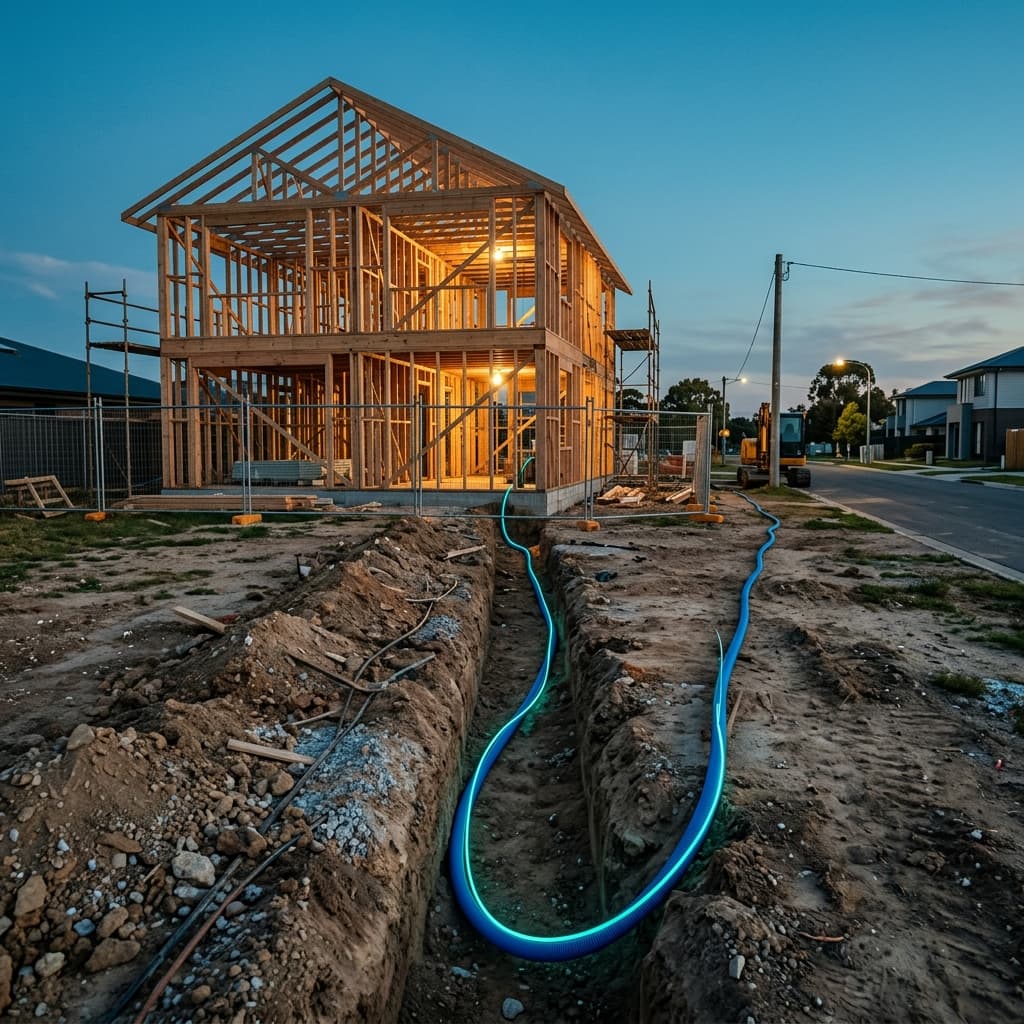
For a new-build house, request the connection as soon as the building permit is granted, lay a rigid 50 mm duct and a telecom panel during the structural work, then order the subscription six to eight weeks before you move in. Recorded on 14 October 2026 from the pages of Proximus, Fiberklaar and Belgian comparison sites.
When should you request the fibre connection for a new-build house?
At permit stage, not at moving stage. That is the advice of Proximus for builders: request "right after the building or subdivision permit is granted", because preparing the connection "can indeed take several months". The network extension works need a permit of their own.
The subscription is not ordered at this stage. Once the house is weatherproof, a Belgian comparison site advises allowing six to eight weeks before the moving date. At Proximus that lead time is shorter for an already connected address, around two weeks, but a new-build is not an already connected address. At Telenet the figure is closer to six weeks, at VOO four. If the works slip, the engineer's appointment can be rescheduled, provided you keep the written confirmation.
Duct of 50 mm and telecom panel: your part of the works
Two items only, but they go in before the trench is filled. The Proximus guide (version of November 2016, to be checked against their current page) describes them as follows:
- a straight trench 60 cm deep, from the facade to the edge of the road;
- a smooth-walled rigid PVC duct of at least 50 mm, with a pull wire sticking out 50 cm at both ends;
- a telecom panel with at least 50 × 70 cm of free space and two earthed 230 V sockets, as close as possible to where the cable enters.
Both ends get a removable plug. Telenet quotes a 40 mm duct, according to a comparison page.
Who lays what between you and the network?
You prepare the ground, the network pulls the cable. Once the duct is in, the site manager sends the construction request form to Proximus's regional address, and Proximus gets in touch to schedule the cable's arrival.
| Step | You (or your contractor) | The network |
|---|---|---|
| Pre-laid duct, from the facade to the street | Lay and protect | Checks it when the cable arrives |
| Telecom panel and two 230 V sockets | Install | Mounts the optical socket on it |
| Connection cable to the public network | Nothing | Lays and connects |
| Internal star cabling | Electrician | Nothing |
| Router, activation | You order | The provider installs |
Split taken from Proximus's guide to connecting single-family houses (November 2016).
A house built flush with the street is the exception: Proximus then lays the duct and the cable itself.
How long should you allow, and what to do depending on your street?
Several months on the network side, two to six weeks on the provider side. The table sorts the cases by the network in front of your plot.
| Your situation | Expected situation in principle | What to do |
|---|---|---|
| New subdivision or building | Proximus says it connects "generally immediately" | Lay duct and panel, order the subscription |
| Fibre already in the street | Extension up to the house | Form at permit stage, duct before backfilling |
| Fibre announced, not yet laid | Connection deferred | Register to be notified, lay the duct anyway |
| No fibre planned | Only copper or cable | VDSL or cable meanwhile |
To put dates on this timeline, here is the countdown for a move-in on 1 June 2027. The last day to order the subscription is 6 April 2027 with eight weeks of margin, 20 April 2027 with six. The connection request to the network itself must have gone out months earlier.
A public complaint filed with Test-Achats in October 2023 describes a three-month wait for a new-build house at Telenet, with a stopgap solution in the meantime. It is an isolated case, but it is a reminder not to wait for the keys.
How much does connecting a new-build house cost?
Between zero and roughly €150, depending on the network and the current promotion. No provider publishes a grid specific to new-builds: the prices below are the standard ones for an existing address.
| Network | Connection | Indoor installation |
|---|---|---|
| Proximus | €90 | €59, free in a pack |
| Telenet (cable) | €50 | depends on the offer |
| VOO | €50 to €75 | depends on the offer |
| Fiberklaar (Flanders) | free | box installed free |
Recorded on 14 October 2026: Proximus, Telenet and VOO according to callmepower.be (indirect source, non-promotional prices), Fiberklaar according to selectra.be. Always ask for a written quote for your address.
The €59 at Proximus falls away with a Flex+ pack, where an engineer's installation is free when self-installation is not possible.
Is fibre mandatory in new construction?
In the building, yes. In your contract, no. European Regulation 2024/1309, known as the Gigabit Infrastructure Act, has applied in full since 12 November 2025. The text, which you can read on EUR-Lex, requires new or heavily renovated buildings to have fibre internal cabling, which helps later, but it says nothing about the day the public network will reach you, nor about the provider that will push it to your socket, and it grants no individual right to a connection.
Wallonia, Brussels, Flanders: who do you write to, and who lays the fibre?
It depends on the province, and the partner contractor changes with the region. Proximus routes site requests to five addresses, recorded on 14 October 2026.
| Region | Provinces | Proximus site contact | Partner fibre contractor |
|---|---|---|---|
| Flanders | West and East Flanders | werf.a1@proximus.com | Fiberklaar |
| Flanders | Antwerp, Limburg, Flemish Brabant | werf.a2@proximus.com | Fiberklaar |
| Brussels | Brussels-Capital Region | chantier.a3@proximus.com | depends on the street |
| Wallonia | Hainaut, Namur, Walloon Brabant | chantier.a4@proximus.com | Unifiber |
| Wallonia | Liège, Luxembourg | chantier.a5@proximus.com | Unifiber (GOfiber in the German-speaking community) |
In mid-2026, around 78 % of homes can be connected in Brussels, 71 % in Flanders and 44 % in Wallonia, figures that keep moving. The BIPT atlas (the Belgian Institute for Postal Services and Telecommunications, IBPT in French) lets you cross-check address by address. In Flanders, the Wyre wholesale network adds to Proximus and Fiberklaar: your street's catalogue depends on which one runs there. Our guide to checking fibre availability explains how to test it.
What if fibre is not in the street yet?
Lay the duct anyway, and register. Proximus lets you sign up to be told when fibre arrives. Laid later, it costs more and complicates everything once the walls and the road are finished.
Meanwhile, VDSL or cable bridge the gap. Our fibre versus VDSL comparison quantifies the speed gap.
What internal cabling should you plan with the electrician?
One Ethernet cable to each useful room, pulled from the telecom panel. Proximus recommends having suitable cabling installed during the works to avoid drilling afterwards. Our guide to Ethernet cable categories settles Cat 5e against Cat 6a. In a new apartment building, also check the shared cabling: Proximus notes that it can cap speeds at 1 Gb/s or 500 Mb/s.
Five mistakes that delay a new-build line
- Requesting the connection at the end of the works. Network works need a permit, and the delay starts running at the request.
- Filling the trench too early. Without a checked duct, the cable does not go through.
- Forgetting the two 230 V sockets on the panel. The modem and router then have nowhere to plug in.
- Mixing up subscription and connection. The first is ordered from a provider, the second depends on the wholesale network.
- Cancelling the old line before the new one is live. Keep the old one until the first successful test.
Installation & éligibilité comparator
Compare all installation & éligibilité side by side.
Compare now →
Frequently asked questions
Nicolas suit le marché belge des télécoms et le déploiement de la fibre depuis plus de huit ans. Ancien technicien réseau devenu analyste indépendant, il teste lui-même les connexions qu'il compare : il mesure les débits réels à différentes heures de la journée, lit les conditions ligne par ligne et traque les hausses de prix qui tombent après douze mois. Son objectif : aider les ménages belges à choisir une offre fibre qui tient ses promesses, au bon débit et au juste prix, sans jargon ni argument commercial.