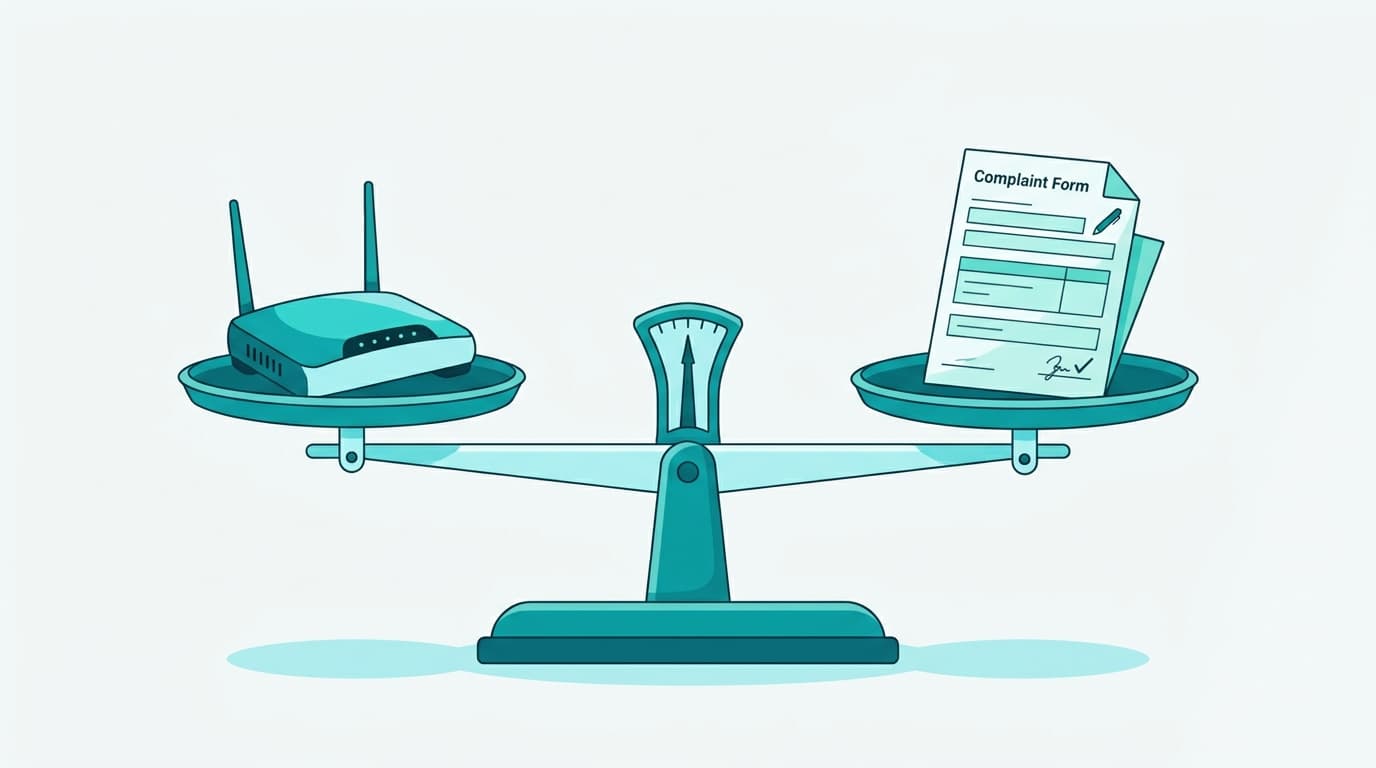
Yes, you can take a telecom complaint to the ombudsman free of charge, through an online form, but only after disputing it in writing with your provider without a satisfactory answer, and in principle within the following year. The opinion binds nobody. In 2025 the service handled 12,445 complaints in 35 days on average. Figures recorded on 2 November 2026.
12,445 complaints in 2025: the ombudsman's balance sheet
The Ombudsman Service for Telecommunications presented its annual report on 26 March 2026. It counts 15,087 requests for intervention, 6.31% fewer than in 2024, including 12,445 genuine mediation complaints and 2,642 requests to identify the authors of malicious communications. The decline is real. The volume stays very high.
| 2025 indicator | Value | Benchmark |
|---|---|---|
| Requests for intervention | 15,087 | 6.31% fewer than in 2024 |
| Mediation complaints | 12,445 | 13,319 in 2024 |
| Malicious communications | 2,642 | 2,785 in 2024 |
| Admissible complaints | 86.31% | |
| Admissible ones settled amicably | 96.72% | |
| Average handling time | 35 days | 34 days in 2024 |
| Cancellation disputes | 909 | up 4% |
| Complaints from individuals | 88.62% | 11.38% from businesses |
Sources: the ombudsman's 2025 annual report, as relayed by Selectra, L'Avenir and the news agency Belga, read on 2 November 2026.
The calculation fits in two lines. Applied to the 12,445 complaints, 86.31% admissibility gives about 10,740 cases examined, and 96.72% amicable settlement about 10,390 agreements. Out of a hundred people who file, around fifteen are turned away and more than eighty reach an arrangement. One reservation: the report does not say what base those rates apply to, so this is an order of magnitude calculated by Nicolas, not an official figure.
Most admissible cases are settled without a judge.
Proximus, Telenet, Orange: who is complained about most?
Proximus, ahead of Telenet, ahead of Orange. But this ranking mostly reflects the size of customer bases, as the ombudsman itself points out according to L'Avenir. It does not say which provider is worst.
| Group | Mediation complaints 2025 | Change vs 2024 |
|---|---|---|
| Proximus (Scarlet included) | 4,539 | -19.65% |
| Telenet (Base included) | 3,884 | -24.42% |
| Orange (VOO and Hey! included) | 3,322 | +32.93% |
| Digi | 461 | arrived in Belgium in December 2024 |
| Unleashed (Mobile Vikings, JIM Mobile) | 295 | +32.29% |
Figures from Selectra and Belga. L'Avenir gives other counts for the same report (Proximus over 5,400, Telenet over 4,600, Orange nearly 3,900) and a 23.29% rise for Orange: the two series probably do not count the same thing, and the sum of the first exceeds the published total by 56. Read orders of magnitude, not units.
Two limits weigh on these numbers. They cover the whole sector, mobile included, and I found no breakdown limited to fixed internet or fibre. Nor do they say how many complaints were declared admissible for each provider.
Billing, contracts, outages: the detail of the grievances
Money first. Billing accounts for nearly three complaints in ten, ahead of contract questions. Outages come only third.
Here is the 2025 split with, in brackets, the order of magnitude in number of complaints (Nicolas's calculation, share applied to the 12,445 complaints):
- Billing, 28.63% (about 3,560): one-off fees, refunds, a subscription still billed after cancellation.
- Contract questions, 23.31% (about 2,900): cancellations, compensation for a service not provided.
- Disruptions, 15.53% (about 1,930): outages and faults that drag on.
- Customer service, 11.35% (about 1,410): absent or contradictory answers.
- Connection, 6.95% (about 865): delays and missed appointments.
- Switching provider, 5.20% (about 650): transfers that go wrong.
The ombudsman wants customers to be able to cancel in a few clicks, as in France, while keeping human contact. The Minister for Consumer Protection, Rob Beenders, asked the BIPT (the Belgian Institute for Postal Services and Telecommunications, IBPT in French) for an in-depth analysis due in the autumn, according to Belga. I found no publication of it on 2 November 2026. If your dispute is about a long outage, our guide on internet outages and compensation gives the thresholds before you contact anyone.

Can you go straight to the telecom ombudsman?
No. The ombudsman is a recourse, not a front desk. It steps in when you have received no satisfactory solution or no answer from your provider, not before.
The European Commission's official entry lists the grounds for refusal: the consumer did not first try to settle the matter with the company, the dispute is frivolous or vexatious, another body or a court is already handling it or has handled it, the complaint is out of time, or handling it would seriously disrupt the service. On the deadline, the legal information site Droits Quotidiens says the ombudsman may refuse a complaint first raised with the provider more than a year earlier, or a case already pending before the justice of the peace. I could not confirm that one-year limit on the ombudsman's own rules of procedure: check it on its website.
The consequence is simple. Your first letter to the provider is the keystone of the future file. Date it, state the amount you claim, keep proof of sending.
How to file a complaint, step by step
The procedure is written and free. Allow one evening to gather the documents, no more.
- Dispute in writing with the provider: email with acknowledgement or registered letter, the date of the dispute, the amount at stake and what you ask for.
- Wait for the answer, or its absence. A refusal or silence opens the way to the ombudsman.
- Gather the documents: contract, bills, exchanges, outage screenshots with dates and times.
- Fill in the form on mediateurtelecom.be, or write to plaintes@mediateurtelecom.be, or call 02 223 06 06.
- Answer the ombudsman's requests: it investigates with the provider and seeks an agreement.
| Step | Time to remember |
|---|---|
| Going to the ombudsman | in principle within one year of the complaint to the provider |
| Handling a mediation complaint | 35 days on average (2025 report) |
| Payment suspension | up to 4 months from filing, if the complaint is admissible |
| Malicious call | 11 days on average |
A simple calculation is reassuring: four months is about 120 days, and the average case is settled in 35. The suspension therefore covers the normal length of a mediation very comfortably, with nearly three months to spare.
A typical case, day by day
Take a fictional case, but tied to the published deadlines: a €120 bill you dispute because it charges a month after an accepted cancellation. The dates are those of a real calendar starting today, the rest is arithmetic.
| Date | Event | To remember |
|---|---|---|
| 4 November 2026 | Dispute emailed to the provider, with acknowledgement | Start of the one-year limit |
| 2 December 2026 | Four weeks without a useful answer: mediation form filed | Start of the payment suspension, if admissible |
| 6 January 2027 | Answer expected at the 35-day average | About 5 weeks after filing |
| 2 April 2027 | End of the four-month maximum suspension | The balance must then be paid or the justice of the peace seized |
| 4 November 2027 | Last day to go to the ombudsman, in principle | One year after the first dispute |
The example shows one thing above all: mediation leaves room, but it cannot be caught up if you let the year slip. Many people wait until the last moment because the outage or the bill seems settled, then find the line is still being debited. As soon as the amount claimed exceeds what you are ready to lose, file.
Do you have to pay the disputed bill during mediation?
In principle no, as long as the complaint is admissible, and for four months at most from filing. That is the rule summed up by Droits Quotidiens: you first dispute the bill with the provider, then, with no answer or no agreement, you go to the ombudsman, and the disputed sum is no longer payable while the case is examined.
Two precautions. Suspend only the part genuinely disputed and pay the rest, otherwise you create an unpaid bill yourself. And do not read this principle as a guarantee: the provider may consider the complaint inadmissible, and the rule should be confirmed with the Ombudsman Service before you stop paying.
Is the ombudsman's opinion binding on the provider?
No. The outcome of the procedure is non-binding, says the European Commission entry. The ombudsman conciliates, it does not convict.
That worries less than it seems: over 96% of admissible cases end amicably, and a provider that knows its refusal will be on record has every interest in settling. But if the agreement fails, nothing stops you from going to the justice of the peace, the usual court for amounts of this kind.
Wallonia, Brussels, Flanders: a single entry point
The Ombudsman Service is federal and sits in Brussels. Same rules, same free service, same form for every resident of the country, whether you live in Namur, Ghent or Ixelles. Complaints are handled in French, Dutch, German and English.
The only regional difference lies in demand: French-language complaints rose from 3,989 in 2024 to 4,560 in 2025, about 14.3% more, while the total fell. The causes of dispute vary with the ground. A fibre connection (FTTH, fibre to the home) that drags on in Flanders, Wallonia or Brussels may depend on a partner contractor (Fiberklaar, Unifiber, Wyre) but, in principle, the operator that signed the contract answers to the customer. Our guide to cancelling and switching provider details the exit rules, including Easy Switch, the official switching procedure.
Five situations, five recourses
| Your situation | First recourse | Why |
|---|---|---|
| Bill, outage, cancellation or compensation disputed | Telecom ombudsman | free, 35 days on average |
| Malicious calls or messages | The ombudsman's dedicated form | 11 days on average |
| Misleading advertising or sale | FPS Economy | oversight of commercial practices |
| Large amount, no agreement possible | Justice of the peace | the only decision that is enforceable |
| Contract older than six months to leave | Direct cancellation, FPS Economy rule | free exit, no mediation needed |
For a commitment period, an introductory price or an increase after twelve months, the ombudsman is not the first reflex: read internet without commitment first, then come back here if the provider holds its ground. And to choose an offer that will not land you in this position, our ranking of the best fibre deals compares on real cost.
The limits of these figures
Three things are missing. No breakdown by product, so nothing specific to fixed internet. No admissibility rate by provider. No handling time by provider. The numbers come from the press that relayed the report, not from the full PDF, and two sources differ on the counts by group. The ombudsman's "How to file a complaint" and "Rules of procedure" pages could not be read in full: the one-year limit and the four-month suspension come from a legal information site, so check them before relying on them.
Installation & éligibilité comparator
Compare all installation & éligibilité side by side.
Compare now →
Frequently asked questions
Nicolas suit le marché belge des télécoms et le déploiement de la fibre depuis plus de huit ans. Ancien technicien réseau devenu analyste indépendant, il teste lui-même les connexions qu'il compare : il mesure les débits réels à différentes heures de la journée, lit les conditions ligne par ligne et traque les hausses de prix qui tombent après douze mois. Son objectif : aider les ménages belges à choisir une offre fibre qui tient ses promesses, au bon débit et au juste prix, sans jargon ni argument commercial.