
No, fibre does not blow up your electricity bill: an internet box draws 7 to 10 watts around the clock, which is €13 to €31 a year in Belgium, and fibre adds only a few euros. The real weight comes from the equipment stacked around the box. Figures checked on 26 October 2026.
A box costs less than you think, and that is the trap
The thesis of this article fits in one line: a box's consumption is a false problem, but it hides a real one. A device drawing 10 W continuously uses 88 kWh over a year. That is small next to the 3,500 kWh an average household uses, according to the calculation assumption used by CallMePower, a Belgian comparison site. It makes barely a fortieth of annual consumption.
Only, a box never lives alone. It comes with a TV box, sometimes a Wi-Fi repeater, an old modem forgotten in a cellar drawer, a socket that is always live. The sum ends up showing on the meter reading.
How much power does an internet box use, in watts and kWh?
The most solid benchmark is the annual survey by ARCEP, the French regulator, published in May 2026. A box that is on, with Wi-Fi off and nobody connected, draws on average 7.3 W. Switching Wi-Fi on adds about 1.8 W. Connecting devices and browsing add another 0.4 W and 0.6 W. In everyday use the average is 10.1 W, according to the ARCEP document. These measurements cover French boxes, not Belgian ones: more on that below.
Here is what that gives in kWh and euros. The conversion rule is simple: each watt drawn continuously is 8.76 kWh a year.
| Situation | Power | kWh per year | Cost at €0.20/kWh | Cost at €0.35/kWh |
|---|---|---|---|---|
| Efficient box (bottom of the sample) | 3.3 W | 29 | €5.78 | €10.12 |
| Box on, Wi-Fi off (ARCEP average) | 7.3 W | 64 | €12.79 | €22.38 |
| Box in everyday use (ARCEP average) | 10.1 W | 88 | €17.70 | €30.97 |
| Fibre with a separate ONT (press figure) | 11.3 W | 99 | €19.80 | €34.65 |
| Box with built-in hard drive (press figure) | 19.4 W | 170 | €33.99 | €59.48 |
| Old equipment (CallMePower assumption) | 25 W | 219 | €43.80 | €76.65 |
Calculation by Nicolas, checked on 26 October 2026. The 7.3 and 10.1 W figures come from ARCEP; the 3.3, 11.3 and 19.4 W figures come from Journal du Geek (19 June 2026), which relays the same survey, though I did not find them in the official extract I consulted; the 25 W comes from CallMePower. The €0.35 kWh price is CallMePower's for a household using 3,500 kWh a year, taxes and network charges included (article of 31 July 2026). The same source shows an average of 20.07 cents per kWh in October 2026 without explaining the gap, so I bracket the calculation with both prices.
One reassuring detail: CallMePower's Belgian figure for a modem and router, 64 kWh a year or about €22, lands exactly on the 7.3 W line of the table.
At rest or mid-stream, the box draws almost the same power
This is the least intuitive result of the survey. A box doing nothing consumes almost as much as a box streaming a film: watching a 1080p episode adds only 0.1 to 1.2 W, according to Journal du Geek. Use itself accounts for at most 10 % of consumption.
The practical consequence: saving by "using the internet less" makes no sense. The power is set by the hardware, not by your habits. The only lever is the hardware itself, or how long it stays powered.
Does fibre use more electricity than another connection?
A little more, in one specific case: when an optical terminal (ONT, the small device that turns light into an Ethernet signal) is installed on top of the box. The press reports 11.3 W on average for that setup, against 9.1 W for a box with Wi-Fi idle. The gap is 2.2 W, i.e. 19 kWh and €6.75 a year at €0.35/kWh.
But here is the weak point of the whole literature: no published measurement compares Belgian modems with one another. Neither the Proximus Internet Box fibre user guide, nor the Internet Box+ one, nor Telenet's modem compliance sheet gives a power figure in watts (documents consulted on 26 October 2026). The Proximus ONT guide, for its part, comes back as an empty file. To understand better what that device does, our article on the ONT box explains its role.
The most prudent reasoning therefore runs in two steps: a fibre plan does not cost more to power simply because it is fibre, but it costs a few euros more when the provider requires an extra box, something only the label on your own installation can confirm.
Does switching your box off at night really change anything?
The objection deserves a number. A 9.1 W box switched off eight hours a night saves about 26.6 kWh a year, i.e. €9.30 at €0.35/kWh. An unplugged adapter drops to 0.1 W. The saving exists.
It is also tiny, and it has a price in comfort. Proximus installs its updates at night, according to CallMePower, and a box that is off cuts the landline, the TV and the connected services that depend on it.
For an absence of a month or more, the calculation changes: unplugging the box and TV box avoids paying for 109 kWh a year at full tilt, in other words 9 kWh a month.
The real cost driver: TV box, repeater and old equipment
A box on its own at 10 W weighs €31 a year at €0.35/kWh. Add the rest and the bill doubles.
- The TV box: 4.1 W on standby on average according to ARCEP, from 0.2 to 15.4 W depending on the model, and 7.4 W in use.
- The Wi-Fi repeater: 5.6 W continuously according to Journal du Geek, i.e. 49 kWh and €17 a year for a device that is sometimes used two hours a day.
- The old modem or second box left plugged in after a change of provider: up to 25 W, so €77 a year at €0.35/kWh.
- The box with a hard drive: 19.4 W on average, a cost doubled for a function almost nobody uses.
For a household combining a box (10.1 W), a TV box on standby (4.1 W) and a repeater (5.6 W), the total reaches 19.8 W, i.e. 173 kWh and about €61 a year at €0.35/kWh. CallMePower, for its part, gives 109 kWh and €38 for a modem and TV box alone. If you are weighing a repeater against another coverage solution, the full comparison is in our guide to repeater, powerline or mesh.
What do Belgian providers publish about their equipment's consumption?
Almost nothing. That is useful information in itself: the electricity cost of a fibre subscription appears in no comparison site, and no provider advertises it.
| Case | Documentation consulted | What to do |
|---|---|---|
| Proximus Internet Box fibre or Box+ | No power figure in the user guide | Read the power adapter label, or measure |
| Telenet modems | No power figure in the DOCSIS compliance sheet | Same |
| Orange, VOO, Digi, Scarlet | Nothing found | Same, or ask support |
| Equipment rented from the provider | It remains the provider's property (CallMePower) | Return it at the end of the contract, do not leave it plugged in |
Documents consulted on 26 October 2026.
None of this is a criticism: a provider has no obligation to print its box's power draw in a user guide. But a reader comparing two fibre plans on a €5 monthly gap would do well to know that the box itself costs €1 to €3 a month in electricity, whichever plan is chosen.
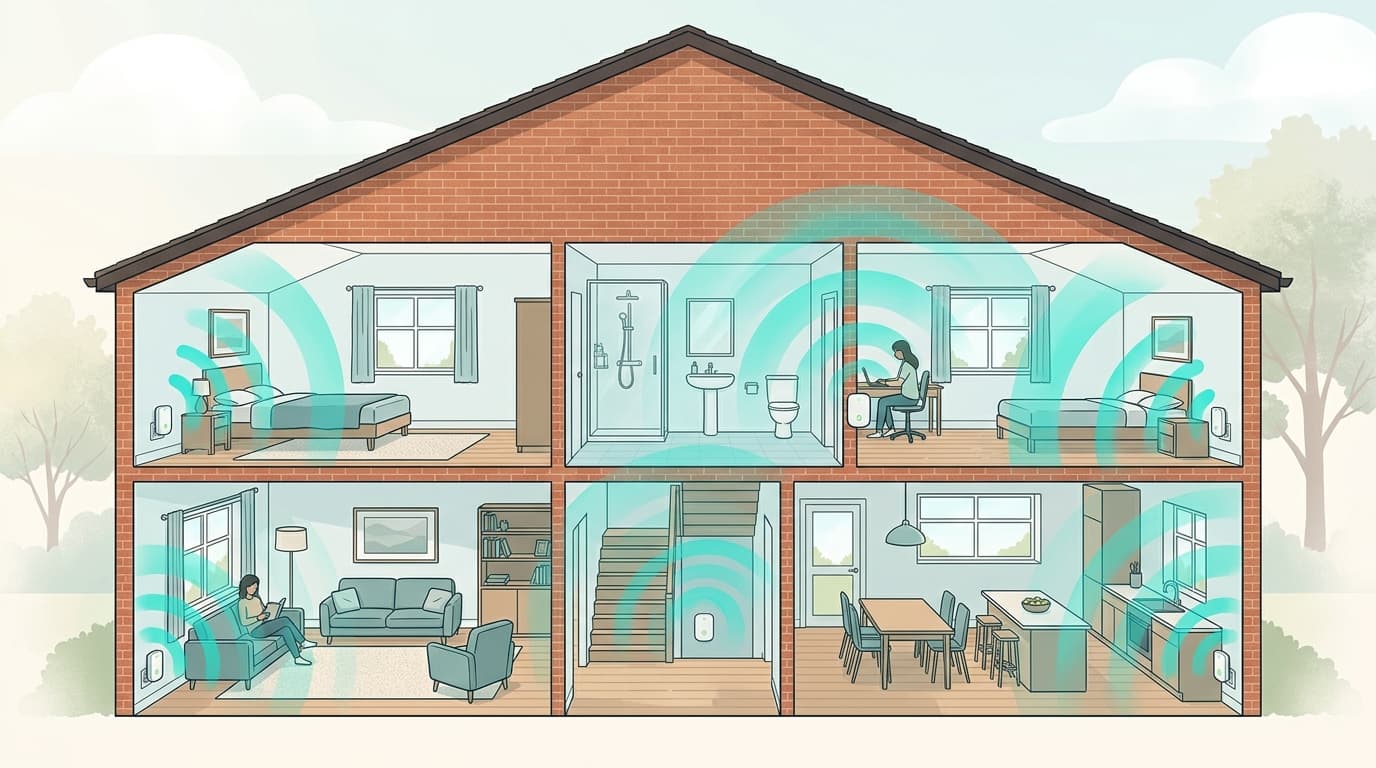
Three regions, one order of magnitude
A box's consumption does not depend on the region: 10 W is 10 W in Brussels, Flanders and Wallonia. Only the starting bill moves. The kWh price varies from one supplier to another and, with network tariffs, from one region to another; I did not record a per-region average on this date, hence the €0.20 to €0.35 bracket.
Fibre coverage, by contrast, varies a lot: roughly 78 % in Brussels, 71 % in Flanders and 44 % in Wallonia in mid-2026, figures that keep moving. Whether your address is served by the Proximus, Fiberklaar or Wyre network, the rule is the same: the provider supplies the equipment, and its model, not your region, sets the power draw. Check what serves your street on the BIPT atlas (the Belgian telecom regulator, IBPT in French).
How do you measure your own box's consumption in ten minutes?
Three methods, from fastest to most reliable.
- Read the power adapter label: it gives an output in volts and amps. Multiply the two and you get the maximum power, which overstates real consumption.
- Plug a socket power meter between the box and the wall, leave it for a day, then read the kWh shown. It is the only way to know your own box.
- Compare your electricity meter reading before and after unplugging every digital device for a weekend, if your digital meter displays it.
Multiply the result by 8.76 if you have watts, then by your kWh price. And if you want the price of the subscription itself, it is in our analysis of the fibre price after the promotion.
Prix & promos comparator
Compare all prix & promos side by side.
Compare now →
Frequently asked questions
Nicolas suit le marché belge des télécoms et le déploiement de la fibre depuis plus de huit ans. Ancien technicien réseau devenu analyste indépendant, il teste lui-même les connexions qu'il compare : il mesure les débits réels à différentes heures de la journée, lit les conditions ligne par ligne et traque les hausses de prix qui tombent après douze mois. Son objectif : aider les ménages belges à choisir une offre fibre qui tient ses promesses, au bon débit et au juste prix, sans jargon ni argument commercial.